Have you ever seen the word “natzi” online and wondered if it is a different term or just a spelling mistake? You’re not alone. Many people accidentally write or search for natzi vs nazi, especially when typing quickly or relying on sound instead of spelling.
The truth is simple but important: one of these spellings is correct, while the other is a frequent error. Understanding the difference between natzi vs nazi not only improves your writing accuracy but also ensures clarity, respect in communication, and proper use of historically sensitive terms in English.
Quick Answer
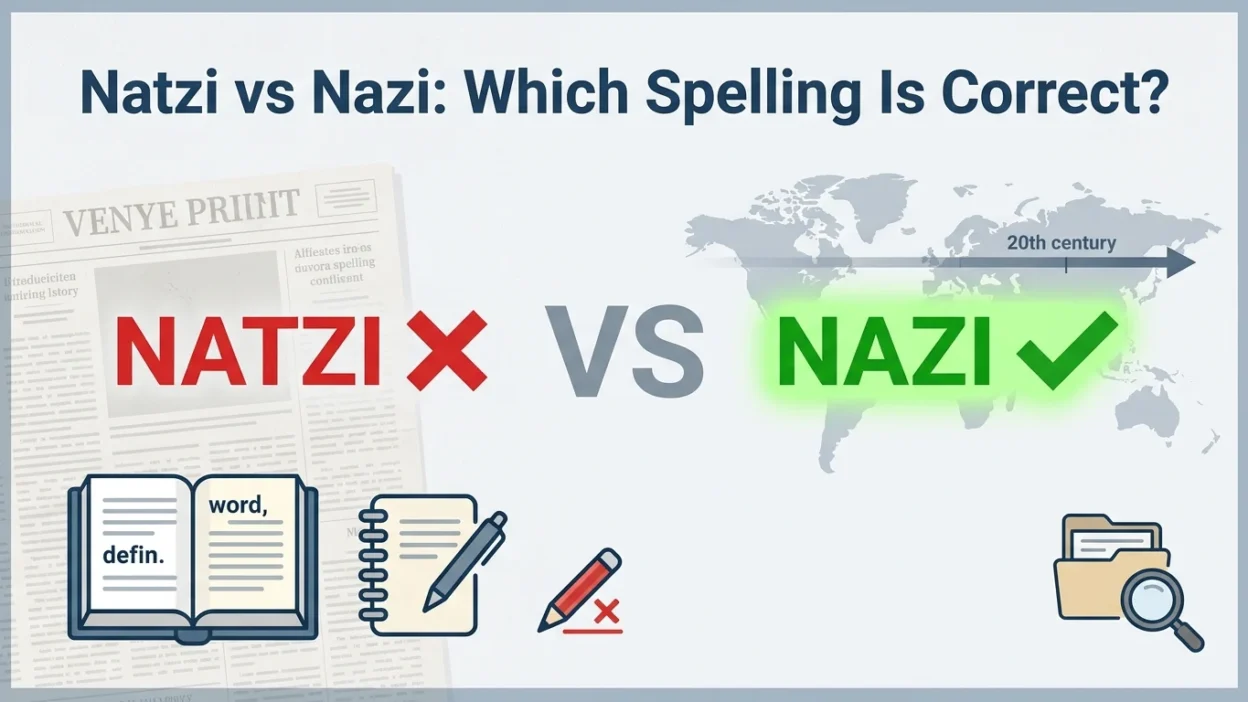
Nazi is the correct spelling.
- ✅ Nazi = Refers to a member of the National Socialist German Workers’ Party (historical political term).
- ❌ Natzi = Incorrect spelling (common typing or pronunciation-based error).
Examples
- The history of the Nazi regime is widely studied.
- Many documents refer to Nazi Germany during World War II.
- ❌ The history of the Natzi regime is widely studied.
In standard English writing, always use Nazi.
What Does “Nazi” Mean?
The word Nazi is a historical term derived from the abbreviation of the German political party name Nationalsozialistische Deutsche Arbeiterpartei (NSDAP).
It is used to describe:
- Members of that political party
- The regime led by Adolf Hitler (1933–1945)
- Ideologies associated with that regime
In modern English usage, it is primarily used in historical, academic, and political discussions.
Examples of Correct Usage
- The Nazi regime collapsed in 1945.
- Many countries opposed Nazi expansion during World War II.
- Historical archives document Nazi policies.
- The museum displays artifacts from the Nazi era.
Because of its historical weight, the term is always used carefully and contextually.
Is “Natzi” a Real Word?
No.
Natzi is not a recognized English word. It is simply a misspelling of Nazi.
Why the Mistake Happens
People often write “natzi” because of:
- Phonetic spelling (how it sounds when spoken)
- Fast typing errors
- Misunderstanding of German pronunciation
- Lack of familiarity with the correct spelling
Incorrect Usage Examples
❌ The natzi party ruled Germany.
❌ Natzi soldiers were involved in the war.
Correct Usage Examples
✅ The Nazi party ruled Germany.
✅ Nazi soldiers were involved in the war.
Natzi vs Nazi: Side-by-Side Comparison
| Feature | Natzi | Nazi |
|---|---|---|
| Correct spelling | ❌ No | ✅ Yes |
| Recognized word | ❌ No | ✅ Yes |
| Found in dictionaries | ❌ No | ✅ Yes |
| Historical accuracy | ❌ Incorrect | ✅ Correct |
| Used in academic writing | ❌ No | ✅ Yes |
| Standard English usage | ❌ No | ✅ Yes |
The comparison clearly shows that Nazi is the only correct form.
Why Spelling Accuracy Matters Here
Unlike casual spelling mistakes, natzi vs nazi is important because:
- It refers to a real historical subject
- It appears in academic research and education
- It is used in legal, historical, and political writing
- Incorrect spelling can reduce credibility
Even small spelling errors can create confusion or make writing appear unprofessional.
Common Mistakes People Make
Mistake #1: Writing “Natzi” Instead of “Nazi”
This is the most common error.
❌ The natzi invasion changed history.
✅ The Nazi invasion changed history.
Mistake #2: Pronunciation-Based Spelling
Since “Nazi” is often pronounced quickly, some assume there is a “t” sound in the word.
However:
- Correct pronunciation does NOT include a “t” sound.
Mistake #3: Typing Errors
Fast typing on mobile devices often leads to:
- natzi ❌ instead of nazi ✅
Mistake #4: Assuming It’s an Alternative Spelling
Some people mistakenly think “natzi” is a regional variation. It is not.
Meaning and Historical Context of “Nazi”
The term is strongly associated with a specific historical period.
Historical Background
The Nazi Party ruled Germany from 1933 to 1945 under Adolf Hitler. It played a central role in World War II and is associated with:
- Totalitarian governance
- Military expansion
- Human rights violations
- The Holocaust
Because of this, the word is used carefully in academic and historical writing.
Modern Usage
Today, “Nazi” is used primarily in:
- History textbooks
- Academic research
- Documentaries
- Museum exhibits
- Political analysis
It is never used casually or positively in modern communication.
Examples of “Nazi” in Sentences
Academic Writing
- Scholars analyze Nazi propaganda techniques.
- Research focuses on Nazi ideology and control systems.
Historical Discussion
- The fall of the Nazi regime marked the end of World War II.
- Many countries opposed Nazi expansion in Europe.
Educational Context
- Students learn about the consequences of Nazi rule.
- Museums preserve artifacts from the Nazi period.
American vs British English Usage
There is no spelling difference between American and British English for this term.
American English
- Nazi ✅
- Natzi ❌
British English
- Nazi ✅
- Natzi ❌
Both forms of English use the same spelling because the word originates from German historical terminology.
Why “Nazi” Is Always Spelled with One “T” Missing
A common confusion arises because English speakers try to match pronunciation with spelling.
However:
- The word comes from German abbreviation
- It does not follow English phonetic spelling rules
- There is no “t” in the original formation
So the correct spelling remains:
- N-A-Z-I
Related Keywords and LSI Terms
When users search for natzi vs nazi, they often look for related concepts such as:
- Correct spelling of Nazi
- Nazi meaning
- Common spelling mistakes
- German political history
- World War II terminology
- Frequently misspelled words
- English spelling rules
- Historical vocabulary
- Grammar correction
- Typing errors in English
These related terms help improve understanding and context.
Frequently Asked Questions
Is natzi a correct spelling?
No. Natzi is incorrect. The correct spelling is Nazi.
Why do people write natzi instead of nazi?
It usually happens due to typing errors or spelling based on pronunciation.
What does Nazi mean?
It refers to members of the National Socialist German Workers’ Party and their historical regime in Germany.
Is Nazi a German word?
It is an abbreviation derived from German political terminology.
Is there any difference between American and British spelling?
No. Both use Nazi.
Is Nazi used in modern English?
Yes, but mainly in historical and academic contexts.
Why is spelling Nazi correctly important?
Because it is a historically significant term and appears in education, research, and official writing.
Can natzi be used in informal writing?
No. It is still incorrect spelling regardless of context.
Summary
The comparison between natzi vs nazi is straightforward: only Nazi is the correct and recognized spelling in English. The term refers to a historical political group and is widely used in academic, historical, and educational contexts. The misspelling natzi has no meaning in standard English and usually appears due to typing errors or phonetic confusion.
Because of the historical importance of the word, using the correct spelling is essential for clarity, accuracy, and credibility in writing. Whether you are writing essays, reports, or online content, always use Nazi to ensure correct and professional communication.

Jhon Thomson is a creative content writer at NickHive, specializing in usernames and nickname ideas. He enjoys exploring name trends, online identity culture, and branding inspiration. With a passion for digital creativity, Jhon helps readers discover unique, stylish, and meaningful names for social media, gaming, and personal branding.