Have you ever paused while writing and wondered whether it should be occurring or occuring? You’re certainly not alone. This is one of the most commonly misspelled words in English because the spelling rule behind it isn’t immediately obvious. Many writers, students, professionals, and even native speakers occasionally get it wrong.
The good news is that once you understand the grammar rule, the confusion disappears. In this guide, we’ll break down occurring vs occuring, explain which spelling is correct, show practical examples, highlight common mistakes, and provide simple memory tricks to help you remember the correct form every time.
Quick Answer
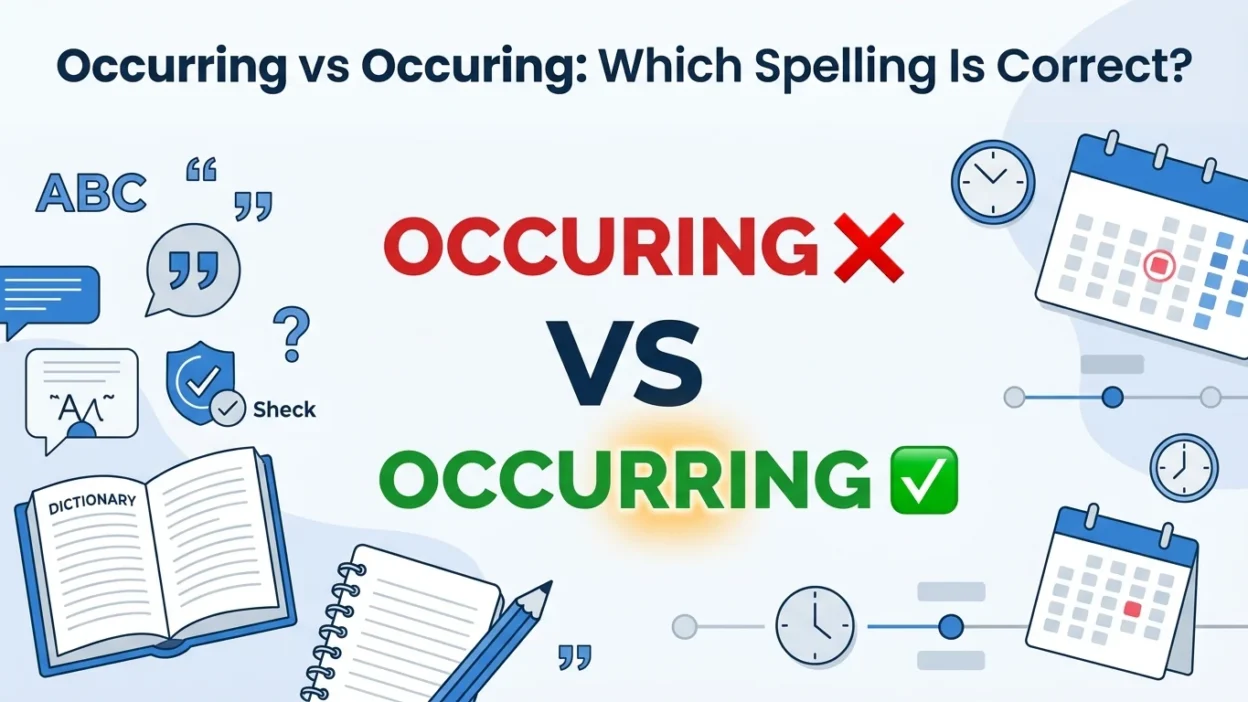
Occurring is the correct spelling.
- ✅ Occurring = Happening, taking place, or existing.
- ❌ Occuring = Incorrect spelling.
Examples
- The event is occurring next week.
- A rare phenomenon is occurring in the region.
- ❌ The event is occuring next week.
In standard English, occurring with a double “r” is always the correct form.
What Does “Occurring” Mean?
The word occurring is the present participle and gerund form of the verb occur.
It means:
- Happening
- Taking place
- Existing
- Arising
- Coming about
The word is frequently used in both formal and informal English.
Examples of Occurring
- The meeting is occurring at noon.
- Changes are occurring throughout the industry.
- An unusual weather pattern is occurring this year.
- Several issues are occurring simultaneously.
- The incident is currently occurring near the city center.
In each example, the word describes something that is happening or taking place.
Is “Occuring” a Real Word?
No.
Occuring is not considered a correct spelling in standard English dictionaries.
It is simply a misspelling of occurring.
Because the pronunciation sounds similar, many people mistakenly drop one of the “r” letters when writing the word.
Incorrect Examples
❌ The accident is occuring right now.
❌ Significant changes are occuring in the market.
Correct Examples
✅ The accident is occurring right now.
✅ Significant changes are occurring in the market.
Occurring vs Occuring: Side-by-Side Comparison
| Feature | Occurring | Occuring |
|---|---|---|
| Correct spelling | ✅ Yes | ❌ No |
| Found in dictionaries | ✅ Yes | ❌ No |
| Accepted in academic writing | ✅ Yes | ❌ No |
| Accepted in professional writing | ✅ Yes | ❌ No |
| Means happening or taking place | ✅ Yes | ❌ No |
| Grammar-approved form | ✅ Yes | ❌ No |
The comparison makes it clear that occurring is the only accepted spelling in modern English.
Why Is “Occurring” Spelled with Two Rs?
The confusion usually comes from English spelling rules involving verbs ending in a stressed consonant.
The base verb is:
occur
When adding -ing, English grammar requires the final consonant to be doubled in certain situations.
The Rule
Double the final consonant before adding -ing when:
- The word ends in a vowel followed by a consonant.
- The final syllable is stressed.
The word occur meets both conditions.
- oc-CUR
- Stress falls on the second syllable.
- Ends with vowel + consonant (“ur”)
Therefore:
- occur + ing
- occurring ✅
Not:
- occuring ❌
Similar Words That Follow the Same Rule
Understanding similar examples can help reinforce the spelling pattern.
| Base Word | Correct -ing Form |
|---|---|
| Refer | Referring |
| Prefer | Preferring |
| Begin | Beginning |
| Admit | Admitting |
| Occur | Occurring |
Notice how each word doubles the final consonant before adding -ing.
Examples of Occurring in Sentences
Everyday English
- What is occurring here?
- Something strange is occurring outside.
- Several conversations are occurring at once.
Business Writing
- Changes are occurring across the organization.
- The issue is occurring in multiple departments.
- Growth is occurring faster than expected.
Academic Writing
- Chemical reactions are occurring within the sample.
- Significant shifts are occurring in consumer behavior.
- The phenomenon is occurring worldwide.
News and Media
- The event is occurring live today.
- Flooding is occurring in several areas.
- Investigations are occurring throughout the region.
These examples demonstrate how versatile and commonly used the word is.
Common Mistakes People Make
Mistake #1: Dropping an R
The most frequent error is spelling the word as occuring.
❌ The discussion is occuring online.
✅ The discussion is occurring online.
Mistake #2: Assuming One R Is Enough
Because some English words don’t double the final consonant, writers often assume the same applies here.
However, occur follows the consonant-doubling rule.
Mistake #3: Mixing Up Pronunciation and Spelling
The pronunciation doesn’t strongly emphasize the double “r,” which makes the mistake more common.
Always remember:
- Pronunciation can be misleading.
- Spelling follows grammar rules.
Mistake #4: Forgetting the Root Word
Many writers focus only on the ending and forget that the base word is occur, not ocur.
Keeping the root word in mind can help prevent errors.
Memory Tricks for Remembering “Occurring”
Simple memory techniques can make the spelling much easier.
Trick #1: Remember the Root Word
Think:
Occur + Ring = Occurring
You keep the original word occur and add -ing while doubling the final “r.”
Trick #2: Connect It to Referring
If you know:
- referring
- preferring
- beginning
then:
- occurring
follows the same pattern.
Trick #3: Think “Double R for Real”
When something is really happening, use:
OccuRRing
The double “R” can serve as a visual reminder.
Common Phrases Using Occurring
The word frequently appears in everyday communication.
Frequently Occurring
Meaning: Happening often.
Example:
- This is a frequently occurring problem.
Naturally Occurring
Meaning: Existing in nature without human intervention.
Example:
- Gold is a naturally occurring element.
Currently Occurring
Meaning: Happening right now.
Example:
- Several events are currently occurring worldwide.
Simultaneously Occurring
Meaning: Happening at the same time.
Example:
- Multiple processes are occurring simultaneously.
These phrases are common in business, science, education, and journalism.
American vs British English
Unlike some words that differ between American and British spelling, occurring is spelled the same in both varieties of English.
American English
- Occurring ✅
- Occuring ❌
British English
- Occurring ✅
- Occuring ❌
There is no regional difference.
Writers in the United States, United Kingdom, Canada, Australia, New Zealand, and other English-speaking countries all use occurring.
Related Words and LSI Keywords
When discussing occurring vs occuring, readers often search for related terms such as:
- Correct spelling
- English grammar rules
- Common spelling mistakes
- Present participle
- Verb forms
- Happening
- Taking place
- English writing tips
- Frequently confused words
- Double consonant rule
- Proper spelling
- Grammar guide
Using these concepts can help strengthen your overall understanding of English spelling patterns.
Frequently Asked Questions
Is occuring a correct spelling?
No. Occuring is a misspelling. The correct spelling is occurring.
Why does occurring have two Rs?
Because the base word occur follows the consonant-doubling rule when adding -ing.
What does occurring mean?
It means happening, taking place, existing, or arising.
Is occurring used in formal writing?
Yes. It is widely used in academic, professional, scientific, and business writing.
How do you use occurring in a sentence?
Example:
- Several important developments are occurring this month.
Is there an American vs British spelling difference?
No. Both American and British English use occurring.
What is the root word of occurring?
The root word is occur.
Why do people spell it as occuring?
Most often because they forget to double the final “r” before adding -ing.
Summary
The comparison between occurring vs occuring is straightforward once you understand the spelling rule. Occurring is the only correct spelling and refers to something that is happening, taking place, or existing. The spelling occuring is a common mistake that results from dropping one of the required “r” letters. Because the verb occur ends with a stressed consonant sound, English grammar requires the final consonant to be doubled before adding ing. This rule also applies to words like referring, preferring, and beginning. Remembering this pattern can help you avoid mistakes and write with greater confidence.
Whether you’re preparing an academic paper, writing a business email, publishing a blog post, or simply improving your English skills, using occurring consistently will make your writing appear more polished, professional, and grammatically accurate.

Jhon Thomson is a creative content writer at NickHive, specializing in usernames and nickname ideas. He enjoys exploring name trends, online identity culture, and branding inspiration. With a passion for digital creativity, Jhon helps readers discover unique, stylish, and meaningful names for social media, gaming, and personal branding.