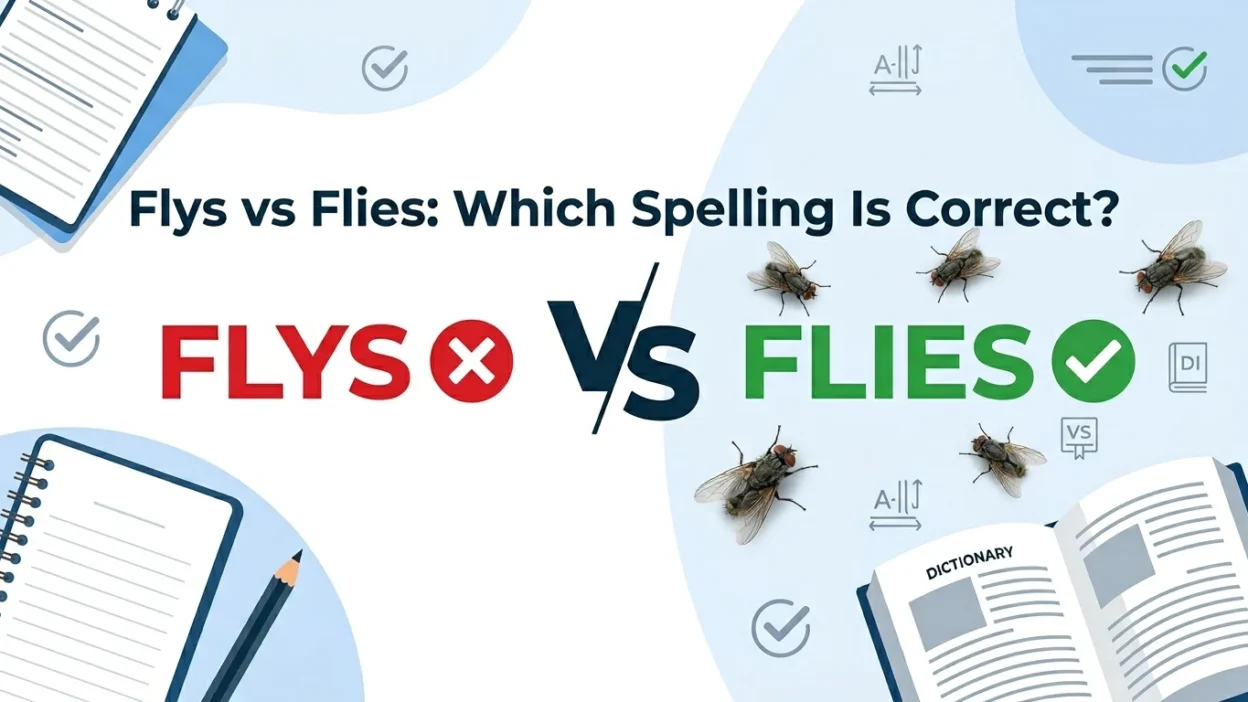
Have you ever paused while writing and wondered whether to use flys or flies? You’re not alone. This is one of those English spelling questions that frequently confuses students, writers, professionals, and even native speakers. Since both forms appear online, it’s easy to assume they’re interchangeable.
The truth is that flies is usually the correct spelling in most situations, while flys has a much more limited and specialized use. Understanding the difference between flys vs flies will help you write with greater confidence and avoid common grammar mistakes. In this guide, we’ll break down the meanings, usage rules, examples, and common errors so you can choose the right word every time.
Quick Answer
In most cases, flies is the correct spelling.
- ✅ Flies = Plural of fly (the insect) or the third-person singular form of the verb fly.
- ⚠️ Flys = A rare alternative form used in specific proper nouns, brand names, or specialized contexts.
Examples
- The bird flies across the sky.
- Several flies landed on the fruit.
- ❌ The bird flys across the sky.
For standard English writing, flies is almost always the correct choice.
What Does “Flies” Mean?
The word flies serves two important grammatical functions in English.
1. Plural of Fly (The Insect)
When referring to more than one insect called a fly, the plural form is flies.
Examples:
- The kitchen was full of flies.
- House flies are common during summer.
- The farmer used traps to reduce the number of flies.
2. Third-Person Singular Form of the Verb Fly
When someone or something performs the action of flying, the correct form is often flies.
Examples:
- She flies to London every month.
- The airplane flies above the clouds.
- Time flies when you’re having fun.
In everyday English, this is one of the most common verb forms.
What Does “Flys” Mean?
The spelling flys is generally considered nonstandard in modern English.
Most dictionaries and grammar guides recognize flies as the correct plural and verb form.
However, flys occasionally appears in:
- Company names
- Brand names
- Surnames
- Historical spellings
- Certain technical or industry-specific usages
Examples:
- A business might intentionally use “Flys” in its brand name.
- Some proper nouns preserve older spellings.
Outside these special cases, flys is usually viewed as a spelling mistake.
Flys vs Flies: Side-by-Side Comparison
| Feature | Flys | Flies |
|---|---|---|
| Standard English spelling | ❌ Usually no | ✅ Yes |
| Plural of fly (insect) | ❌ No | ✅ Yes |
| Verb form of fly | ❌ No | ✅ Yes |
| Used in formal writing | ❌ Rarely | ✅ Yes |
| Found in dictionaries | Limited contexts | ✅ Yes |
| Common modern usage | Very uncommon | Very common |
This comparison makes it clear that flies is the preferred spelling in nearly all writing situations.
Why Is the Plural “Flies” Instead of “Flys”?
English follows a spelling rule for many nouns ending in a consonant followed by y.
When forming the plural:
- Change y to i
- Add es
Examples
| Singular | Plural |
|---|---|
| Fly | Flies |
| Baby | Babies |
| City | Cities |
| Lady | Ladies |
| Party | Parties |
Since fly ends with a consonant (l) followed by y, the plural becomes flies.
This same rule applies when forming the third-person singular verb form.
Examples of Flies as a Noun
Here are some examples where flies refers to insects.
- The picnic attracted dozens of flies.
- Fruit flies are tiny but annoying.
- The horse swatted away the flies.
- Summer heat often increases the number of flies.
- The screen keeps flies out of the house.
In each sentence, flies is the plural noun.
Examples of Flies as a Verb
Now let’s look at flies as a verb.
- The eagle flies gracefully.
- She flies internationally for work.
- The kite flies high in the wind.
- The drone flies autonomously.
- Time flies during vacations.
In these examples, flies describes an action.
Common Mistakes People Make
Understanding common errors can help you avoid them.
Mistake #1: Using Flys as the Plural of Fly
❌ There were many flys near the trash can.
✅ There were many flies near the trash can.
Mistake #2: Using Flys as a Verb
❌ The plane flys over the mountains.
✅ The plane flies over the mountains.
Mistake #3: Assuming Every Word Ending in Y Simply Adds S
English often changes y to ies when a consonant comes before the y.
Incorrect:
- flys
- babys
- citys
Correct:
- flies
- babies
- cities
Mistake #4: Confusing Informal Online Usage with Correct Grammar
Some websites, usernames, and brand names use flys, but that doesn’t make it standard English.
Always follow proper grammar rules in professional writing.
Grammar Rule Behind Flies
One of the easiest ways to remember the correct spelling is to understand the grammar rule.
Consonant + Y Rule
If a word ends in:
Consonant + Y
then:
Y → IES
Examples:
- Fly → Flies
- Cry → Cries
- Try → Tries
- Carry → Carries
This rule explains why flies is correct.
Vowel + Y Exception
When a word ends in:
Vowel + Y
simply add S.
Examples:
- Boy → Boys
- Day → Days
- Toy → Toys
- Key → Keys
This distinction helps prevent many spelling errors.
Common Expressions Using Flies
The word flies appears in several popular English expressions.
Time Flies
Meaning: Time passes quickly.
Example:
- Time flies when you’re enjoying yourself.
Flies on the Wall
Meaning: Observers who watch without participating.
Example:
- I wish I could be a fly on the wall during that meeting.
Flies in the Ointment
Meaning: Small problems that spoil a situation.
Example:
- The delay was the only fly in the ointment.
Learning these expressions can improve both writing and conversation skills.
American vs British English
Unlike some words that differ between American and British spelling, flies remains the standard spelling in both versions of English.
American English
- Flies ✅
- Flys ❌
British English
- Flies ✅
- Flys ❌
There is no regional spelling difference here.
Whether you’re writing for readers in the United States, United Kingdom, Canada, Australia, or elsewhere, flies is the accepted form.
Memory Tricks to Remember the Difference
A few simple tricks can make the spelling easy to remember.
Think of Similar Words
- Fly → Flies
- Cry → Cries
- Try → Tries
If those words use ies, then fly should too.
Remember the Insect Rule
Whenever you’re talking about multiple insects:
- One fly
- Two flies
Never “flys.”
Remember the Verb Rule
When he, she, or it performs the action:
- He flies
- She flies
- It flies
The spelling remains the same.
Related Words and LSI Keywords
When discussing flys vs flies, related terms often include:
- English spelling rules
- Grammar mistakes
- Plural nouns
- Third-person singular verbs
- Commonly confused words
- Correct spelling
- Writing tips
- English language learning
- Verb conjugation
- Singular and plural forms
Understanding these concepts helps strengthen your overall grammar skills.
Frequently Asked Questions
Is flys ever correct?
In standard English grammar, flies is usually correct. Flys may appear in certain proper nouns, brand names, or specialized contexts.
What is the plural of fly?
The plural of fly is flies.
Example:
- Several flies were buzzing around the room.
Is flies a noun or a verb?
It can be both.
- Noun: The flies landed on the table.
- Verb: The bird flies south for winter.
Why isn’t the plural of fly “flys”?
Because English spelling rules change the final y to ies when the word ends with a consonant plus y.
Is flys a spelling mistake?
In most writing situations, yes. Standard English requires flies.
How do you use flies in a sentence?
Example:
- The airplane flies over the city every day.
Do British and American English spell it differently?
No. Both use flies.
Which form should I use in professional writing?
Always use flies unless you’re referring to a specific name, brand, or specialized term that intentionally uses flys.
Summary
The debate over flys vs flies is much simpler than it first appears. In standard English, flies is the correct spelling for both the plural noun form of fly and the third person singular verb form of fly. It follows a common grammar rule that changes a consonant + y ending into ies.
While flys occasionally appears in brand names, proper nouns, and specialized contexts, it is rarely appropriate in everyday writing. Whether you’re writing an email, academic paper, blog post, business document, or social media update, choosing flies will almost always be the correct and professional option.

Will Jack is a passionate content creator at NickHive, focused on crafting unique username and nickname ideas. He explores digital identity trends, gaming aliases, and social media branding styles. With a creative mindset and research-driven approach, Will helps readers discover catchy, memorable, and personalized names for every platform.