If you’ve ever hesitated while writing whos or whose, you’re certainly not alone. These two forms are among the most commonly confused words in English because they sound identical when spoken. Whether you’re drafting an email, writing an academic paper, posting on social media, or creating website content, mixing them up can make even polished writing look less professional.
The good news is that the difference between whos vs whose is surprisingly easy to understand once you learn one simple rule. In this guide, you’ll discover the correct meanings, practical examples, common mistakes, memory tricks, and expert tips to help you use these words confidently every time.
Quick Answer
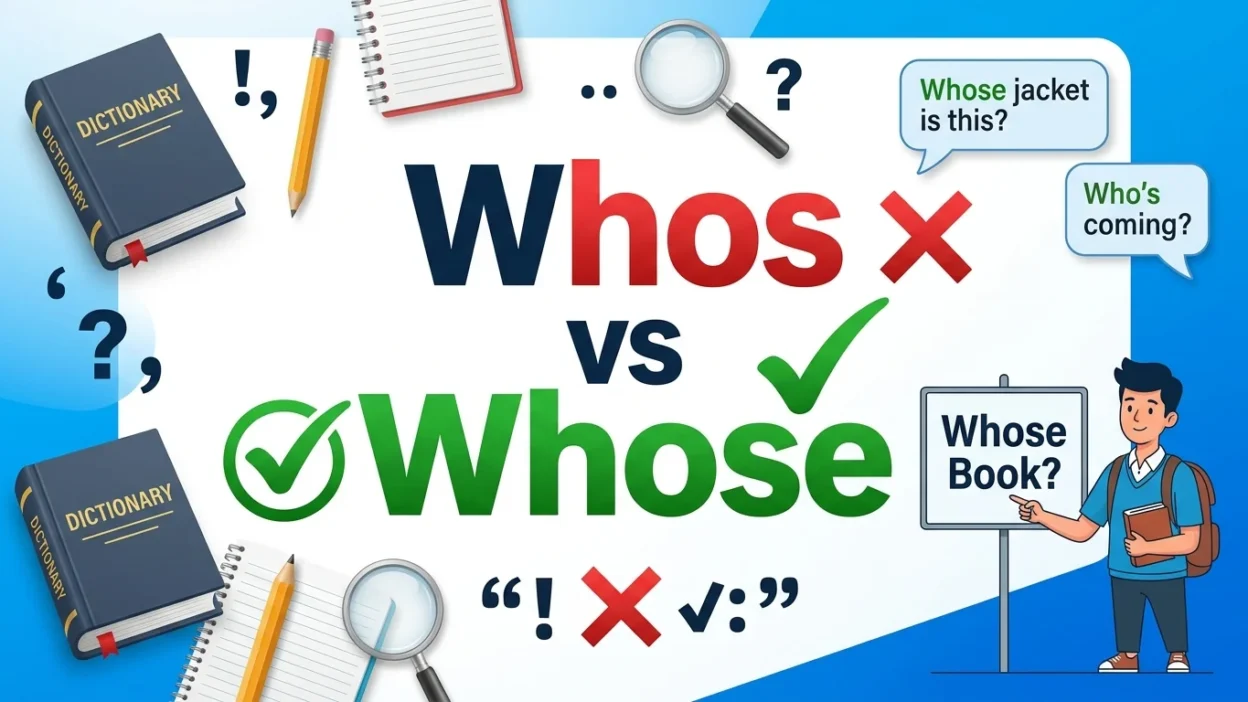
Whose is the correct word when showing possession or ownership.
Whos without an apostrophe is generally considered incorrect in standard English.
Examples:
✅ Correct: Whose jacket is on the chair?
❌ Incorrect: Whos jacket is on the chair?
Also remember:
✅ Who’s (with an apostrophe) means who is or who has.
Many people searching for whos vs whose are actually comparing who’s vs whose, which is where most of the confusion comes from.
Whos vs Whose: What’s the Difference?
Let’s start with the basics.
| Word | Correct? | Meaning |
|---|---|---|
| Whose | ✅ Yes | Shows ownership or possession |
| Whos | ❌ No | Not a standard English word |
| Who’s | ✅ Yes | Contraction of “who is” or “who has” |
The confusion often occurs because people accidentally leave out the apostrophe in who’s or mistakenly use who’s when they need whose.
What Does “Whose” Mean?
Whose is a possessive pronoun and possessive determiner.
It is used when asking or stating who owns, possesses, or is connected to something.
Think of whose as meaning:
- Belonging to whom
- Owned by whom
- Associated with whom
Examples of Whose
- Whose phone is ringing?
- Do you know whose keys these are?
- The teacher asked whose notebook was missing.
- Whose idea was it to start the project?
- We found the student whose bag was left behind.
In all these examples, whose indicates ownership or possession.
What Does “Who’s” Mean?
Although the keyword is whos vs whose, understanding who’s is essential because this is where most mistakes occur.
Who’s is a contraction.
It means either:
- Who is
- Who has
Examples of Who’s
- Who’s coming to the meeting?
- Who’s ready for dinner?
- Who’s been using my computer?
- Who’s responsible for this report?
You can test it by expanding the contraction.
Example:
- Who’s coming?
- Who is coming?
The sentence still makes sense, so who’s is correct.
Why “Whos” Is Incorrect
Unlike words such as:
- Whats
- Thats
- Its
which sometimes appear informally online, whos without an apostrophe is not accepted in standard English grammar.
Examples:
❌ Whos car is parked outside?
✅ Whose car is parked outside?
❌ Whos going to the party?
✅ Who’s going to the party?
Whenever you see whos, it is usually a spelling or punctuation mistake.
Understanding Possession with Whose
Possession is the key function of whose.
Questions About Ownership
- Whose laptop is this?
- Whose house are we visiting?
- Whose responsibility is it?
Relative Clauses
- I met a woman whose son is a doctor.
- The company whose products we use is expanding.
- The athlete whose record remains unbeaten retired last year.
In these examples, whose connects a person or thing to something they possess.
Common Mistakes with Whos vs Whose
Mistake 1: Using Whos Instead of Whose
❌ Whos umbrella is this?
✅ Whose umbrella is this?
Mistake 2: Using Who’s for Possession
❌ Who’s backpack is on the floor?
✅ Whose backpack is on the floor?
Since the sentence refers to ownership, whose is required.
Mistake 3: Using Whose Instead of Who’s
❌ Whose coming to lunch?
✅ Who’s coming to lunch?
The sentence means:
“Who is coming to lunch?”
Therefore, who’s is correct.
Easy Memory Trick
One of the simplest ways to remember the difference is this:
Whose = Possession
If you’re talking about ownership, use whose.
Examples:
- Whose shoes?
- Whose book?
- Whose idea?
Who’s = Who Is or Who Has
If you can replace the word with who is or who has, use who’s.
Examples:
- Who’s arriving soon?
- Who’s finished the assignment?
Quick Test
Ask yourself:
Can I replace it with “who is”?
If yes → use who’s.
If no and ownership is involved → use whose.
Comparison Table: Whos vs Whose vs Who’s
| Word | Meaning | Example |
|---|---|---|
| Whose | Possession or ownership | Whose car is outside? |
| Who’s | Who is / Who has | Who’s coming tonight? |
| Whos | Incorrect form | Not standard English |
This table summarizes the entire rule in a glance.
Real-Life Examples
- Whose turn is it?
- Who’s calling me?
- Do you know whose wallet this is?
- Who’s been using my charger?
- Please identify whose approval is required.
- Who’s responsible for the final report?
- We need to determine whose account was affected.
- Researchers examined whose data had been omitted.
- Who’s contributing to the project this semester?
These examples show how frequently these words appear in professional and personal communication.
American vs British English
One helpful aspect of this grammar rule is that it remains the same in both major varieties of English.
| American English | British English |
|---|---|
| Whose | Whose |
| Who’s | Who’s |
| Whos | Incorrect |
There is no spelling difference between American and British English regarding these words.
Examples:
- American English: Whose bag is this?
- British English: Whose bag is this?
The grammar rules are identical.
Why This Mistake Is So Common
Several factors contribute to the confusion.
They Sound Identical
Whose and who’s are homophones.
Homophones are words that sound the same but have different meanings and spellings.
Apostrophes Cause Confusion
Many writers assume possessive words require apostrophes.
For example:
- John’s book
- Sarah’s laptop
Because of this pattern, people often incorrectly write who’s when they mean whose.
Fast Typing
In emails, texts, and social media posts, writers often omit apostrophes or choose the wrong form without noticing.
Related Grammar Confusions
If you struggle with whos vs whose, you may also encounter similar word pairs:
- Its vs It’s
- Your vs You’re
- Their vs There vs They’re
- Than vs Then
- To vs Too vs Two
These are common English homophones that require attention to meaning rather than pronunciation.
Why Correct Usage Matters
Using the correct form helps:
- Improve professionalism
- Increase reader trust
- Strengthen academic writing
- Enhance SEO content quality
- Reduce grammar errors
Small grammar mistakes can distract readers from your message. Learning the difference between whose and who’s makes your writing clearer and more credible.
FAQs
Is whos a real word?
No. Whos without an apostrophe is not considered a standard English word.
What is the difference between whos and whose?
Whose shows possession or ownership, while whos is generally a spelling mistake.
Is whose possessive?
Yes. Whose is used to indicate ownership or association.
Is who’s the same as whose?
No. Who’s means who is or who has, while whose shows possession.
How do I know whether to use whose or who’s?
If the sentence involves ownership, use whose. If you can replace the word with who is or who has, use who’s.
Is whos ever correct?
In standard English grammar, no. It is considered incorrect.
Do British and American English use different rules?
No. Both varieties follow the same rules for whose and who’s.
Can whose refer to things as well as people?
Yes. Modern English often uses whose for both people and things.
Example:
The company whose products we sell is expanding.
Summary
Understanding whos vs whose becomes easy once you remember that whos is not a standard English word. The correct form for showing ownership or possession is whose, while who’s is a contraction meaning who is or who has.
Although these words sound identical, their functions are completely different. Whenever you’re writing, ask whether you’re talking about ownership or whether you can replace the word with “who is” or “who has.” This simple check will help you choose the correct form every time and make your writing more polished, professional, and grammatically accurate.

Jhon Thomson is a creative content writer at NickHive, specializing in usernames and nickname ideas. He enjoys exploring name trends, online identity culture, and branding inspiration. With a passion for digital creativity, Jhon helps readers discover unique, stylish, and meaningful names for social media, gaming, and personal branding.