If you’ve ever paused while writing and wondered whether to use more then or more than, you’re not alone. This is one of the most common grammar mistakes in English because the words then and than sound similar when spoken quickly. Even experienced writers occasionally mix them up.
The confusion is understandable, but the difference is actually quite simple once you know the rule. Understanding more then vs more than will help you write with greater confidence, avoid embarrassing errors, and improve both academic and professional communication. In this guide, you’ll learn the correct usage, meanings, examples, common mistakes, and easy tricks to remember the difference.
Quick Answer
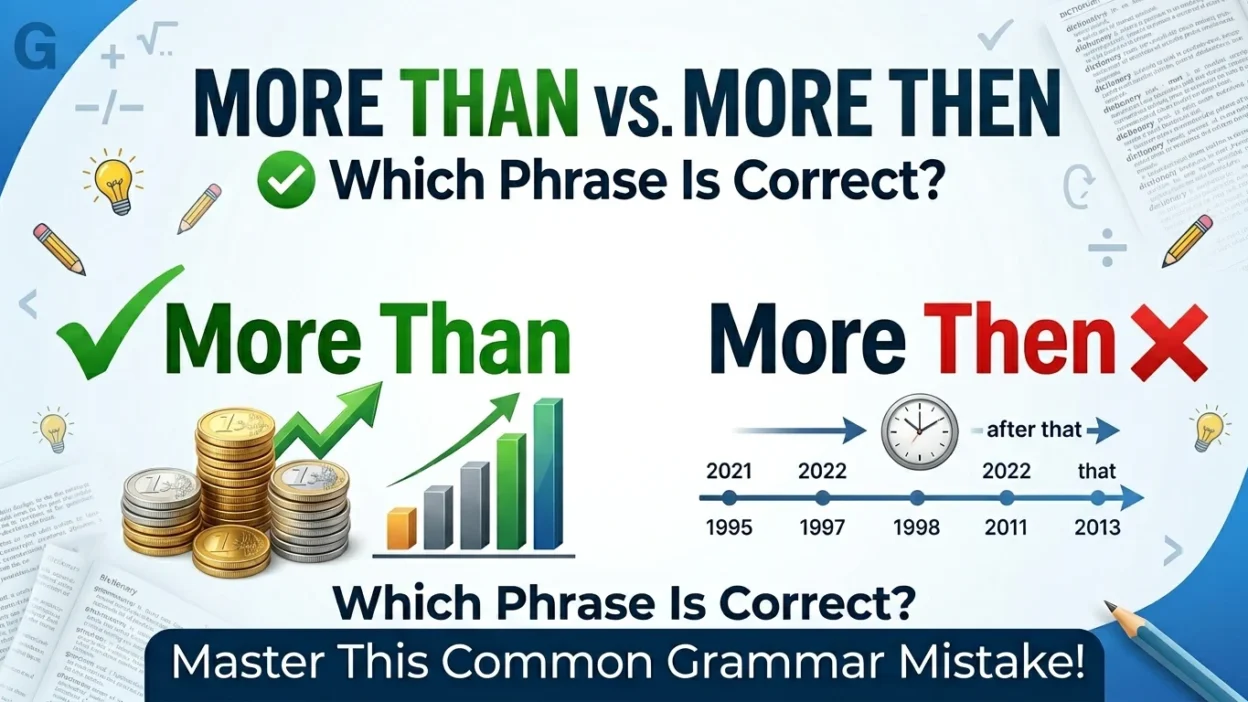
More than is the correct phrase when making a comparison or referring to a quantity greater than something else.
More then is usually incorrect and results from confusing then with than.
✅ Correct: She has more than 100 books.
❌ Incorrect: She has more then 100 books.
In almost every case where you’re comparing amounts, numbers, qualities, or quantities, you should use more than.
More Then vs More Than: The Key Difference
The distinction comes down to the individual meanings of then and than.
| Phrase | Correct? | Usage |
|---|---|---|
| More than | ✅ Yes | Used for comparisons and quantities |
| More then | ❌ Usually No | Grammatical error in most contexts |
To understand why, let’s examine each word separately.
What Does “Than” Mean?
Than is a conjunction or preposition used to make comparisons.
It helps compare:
- Numbers
- Amounts
- Sizes
- Qualities
- Preferences
- Actions
Examples of Than
- She is taller than her brother.
- I have more than enough food.
- This laptop costs more than the previous model.
- He works harder than most people.
- The meeting lasted longer than expected.
Whenever a comparison is involved, than is usually the correct choice.
What Does “Then” Mean?
Then relates to time, sequence, or what happens next.
It often means:
- At that time
- Next
- Afterward
- Subsequently
Examples of Then
- We ate dinner and then watched a movie.
- Finish your homework, then you can play games.
- Back then, smartphones didn’t exist.
- First mix the ingredients, then bake the cake.
Notice that then has nothing to do with comparisons.
Why “More Than” Is Correct
The word more naturally creates a comparison.
When you say:
- More than 10 people
- More than enough
- More than necessary
- More than expected
You’re comparing one amount or degree to another.
Because comparisons require than, the correct phrase is more than.
Examples
- More than fifty students attended the event.
- She earned more than her coworkers.
- The project took more than three months to complete.
- We received more than expected.
- He is more than capable of handling the task.
These examples all involve comparison or excess quantity.
Why “More Then” Is Usually Incorrect
The phrase more then incorrectly substitutes the time-related word then for the comparison word than.
Consider this sentence:
❌ The company earned more then last year.
Because you’re comparing earnings, the sentence should be:
✅ The company earned more than last year.
Using then here changes the grammar and creates an error.
Examples of More Than in Everyday Writing
Numbers and Quantities
- More than 500 people attended the concert.
- The book contains more than 300 pages.
- We sold more than 1,000 products this month.
Comparisons
- She knows more than I do about photography.
- This route is more than twice as fast.
- The new system is more efficient than the old one.
Emphasis
Sometimes more than means “extremely” or “to a great degree.”
Examples:
- I am more than happy to help.
- She was more than excited about the news.
- We are more than grateful for your support.
In these cases, more than adds emphasis rather than a direct comparison.
Common Mistakes with More Then vs More Than
Mistake 1: Using Then Instead of Than
❌ I have more then enough money.
✅ I have more than enough money.
Mistake 2: Confusing Sound with Meaning
Because the words sound similar, many writers rely on pronunciation rather than grammar.
Always focus on meaning:
- Comparison = than
- Time or sequence = then
Mistake 3: Typing Quickly Without Proofreading
Many instances of more then happen because of typing habits rather than misunderstanding.
A quick proofread can catch the mistake.
Easy Trick to Remember the Difference
A simple memory aid can make the distinction easy.
Than = Comparison
Notice that than contains the letter A.
Think:
A = Comparison of Amounts
Examples:
- More than
- Bigger than
- Better than
- Faster than
Then = Time
Notice that then contains the letter E.
Think:
E = Events in order
Examples:
- First this, then that.
- Back then.
- Then we left.
This small trick helps many writers instantly choose the correct word.
More Than vs Then in Sentence Comparisons
Let’s look at side-by-side examples.
| Incorrect | Correct |
|---|---|
| More then 20 people attended. | More than 20 people attended. |
| She earns more then her sister. | She earns more than her sister. |
| We need more then one solution. | We need more than one solution. |
| The trip cost more then expected. | The trip cost more than expected. |
| He knows more then anyone else. | He knows more than anyone else. |
Every correct version uses than because a comparison is being made.
Situations Where Then Is Correct
Although more then is generally wrong, then itself is perfectly correct in many situations.
Sequence
- First wash the vegetables, then cut them.
Time Reference
- Life was very different back then.
Conditional Actions
- If it rains, then we’ll stay inside.
Storytelling
- He opened the door and then walked into the room.
In these cases, then refers to timing rather than comparison.
American vs British English
Unlike some grammar differences between American and British English, there is no variation here.
Both forms of English follow the same rule:
| American English | British English |
|---|---|
| More than | More than |
| More then | Incorrect |
Examples:
- American English: More than 200 guests attended.
- British English: More than 200 guests attended.
The usage remains identical on both sides of the Atlantic.
Related Words and Phrases
Understanding related comparison words can strengthen your grammar skills.
Comparison Words
- Than
- More than
- Less than
- Rather than
- Greater than
- Better than
Time-Related Words
- Then
- Afterwards
- Later
- Subsequently
- Next
- Eventually
Grouping these words by function helps reinforce their correct usage.
Why This Mistake Matters
Some grammar mistakes are minor, but confusing then and than can affect readability and professionalism.
Correct usage helps:
- Improve writing clarity
- Enhance credibility
- Strengthen academic work
- Build professional trust
- Improve SEO content quality
For bloggers, students, business professionals, and content creators, mastering this distinction is worth the effort.
FAQs
Is more then grammatically correct?
In most situations, no. The correct phrase is more than when making a comparison or discussing quantities.
Why do people write more then instead of more than?
The mistake usually happens because then and than sound similar when spoken.
What does more than mean?
It means a greater amount, quantity, degree, or level compared to something else.
Can more then ever be correct?
Only if the words happen to appear separately in a sentence with different meanings. As a phrase, it is generally incorrect.
Is more than used in American English?
Yes. American English uses more than for comparisons and quantities.
Is more than used in British English?
Yes. British English follows the same rule.
How can I remember the difference between than and then?
Remember: than is for comparisons, while then relates to time and sequence.
What are examples of more than?
- More than 100 people attended.
- More than enough food was available.
- She knows more than anyone else in the group.
Summary
The debate over more then vs more than has a clear answer: more than is the correct phrase when comparing amounts, quantities, qualities, or degrees. The word than is specifically designed for comparisons, while then refers to time, sequence, or events that happen afterward.
Although the mistake is common, it is also easy to fix once you understand the difference. Whenever you’re talking about a larger amount, a higher number, a stronger quality, or a greater degree, choose more than. Reserve then for situations involving time or order. Mastering this simple rule will make your writing clearer, more professional, and more polished.

Martin Smith is a creative writer at NickHive, specializing in unique usernames and nickname ideas. He researches online naming trends, gaming identities, and social media branding strategies. With a sharp eye for originality, Martin helps readers craft memorable, stylish, and meaningful names that stand out across digital platforms.