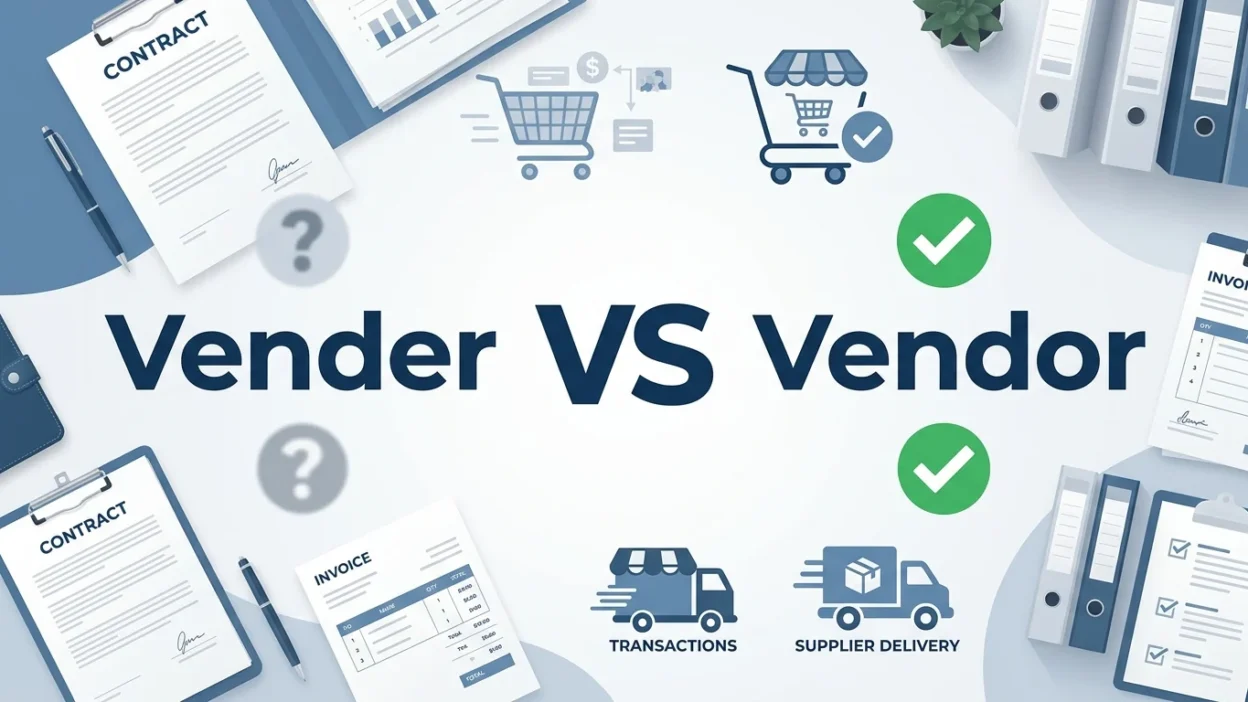
If you’ve ever come across the words vender and vendor, you may have wondered whether they mean the same thing or if one is simply a misspelling of the other. This confusion is surprisingly common, especially among writers, business professionals, students, and English learners.
The good news is that both words are legitimate English terms. However, one is significantly more common in modern usage. Understanding the difference between vender vs vendor can help you write more accurately and avoid mistakes in professional communication, contracts, business documents, and everyday writing.
Quick Answer
Vendor is the preferred and most widely used spelling in modern English.
Vender is also a correct word, but it is far less common and is considered a variant spelling of “vendor.”
In almost all business, commercial, and professional contexts, you should use vendor.
| Term | Meaning | Common Usage |
|---|---|---|
| Vendor | A person or company that sells goods or services | Very common |
| Vender | A variant spelling of vendor | Rare |
What Does Vendor Mean?
A vendor is a person, business, or organization that sells products or services to customers or other businesses.
The word is commonly used in business, commerce, technology, retail, real estate, and procurement.
Examples of Vendor
- The software vendor released a new update.
- We selected a vendor for office supplies.
- Food vendors lined the street during the festival.
- The company works with several international vendors.
In modern business English, vendor is the standard spelling you will encounter most often.
What Does Vender Mean?
Vender has the same meaning as vendor. It refers to someone who sells goods or services.
However, vender is an older and much less common spelling. Today, most dictionaries recognize it as a variant form rather than the preferred spelling.
Examples of Vender
- The property vender signed the contract.
- The vender agreed to transfer ownership.
Although these sentences are technically correct, most readers would expect to see vendor instead.
Vender vs Vendor: Key Differences
The main difference between vender vs vendor is not meaning but usage and popularity.
| Feature | Vendor | Vender |
|---|---|---|
| Meaning | Seller of goods or services | Seller of goods or services |
| Modern Usage | Extremely common | Rare |
| Business Writing | Preferred | Generally avoided |
| Professional Documents | Standard | Uncommon |
| Dictionary Recognition | Standard spelling | Variant spelling |
When in doubt, choose vendor.
Why Is Vendor More Popular?
Language evolves over time, and certain spellings become dominant.
Over the years, vendor became the preferred form in:
- Business communication
- Legal documents
- Procurement contracts
- Supply chain management
- Retail industries
- Technology sectors
Today, major companies, government agencies, and professional organizations overwhelmingly use vendor.
As a result, using vendor helps ensure clarity and aligns your writing with modern standards.
Vendor in Business and Commerce
The term vendor appears frequently in business environments.
Common business phrases include:
- Vendor management
- Vendor relationship
- Preferred vendor
- Vendor agreement
- Vendor contract
- Vendor registration
- Vendor payment
- Vendor database
Example
A company may purchase office equipment from a hardware vendor, software licenses from a technology vendor, and marketing services from a digital marketing vendor.
Because these phrases are so widespread, using vender in such contexts can appear unusual or outdated.
Vendor vs Seller
Many people also compare vendor and seller.
While both words describe someone who sells something, there is a subtle difference.
Seller
A seller is anyone who sells a product, service, or property.
Vendor
A vendor usually refers to a business, supplier, merchant, or commercial seller operating within a professional or organized setting.
Example
- A homeowner selling a house is a seller.
- A software company selling subscriptions is a vendor.
In many situations, the terms overlap, but vendor often sounds more professional and business-oriented.
American vs British English
One common question is whether vender and vendor represent American and British spelling differences.
The answer is no.
Unlike words such as:
- Color vs colour
- Organize vs organise
- Center vs centre
The distinction between vender vs vendor is not an American versus British English issue.
In American English
Vendor is the standard spelling.
In British English
Vendor is also the standard spelling.
Both regions overwhelmingly prefer vendor, making it the safer choice regardless of your audience.
Common Mistakes People Make
Many writers accidentally misuse these terms.
Mistake 1: Assuming Vender Is Wrong
Some people believe vender is incorrect.
In reality, it is a recognized variant spelling, though uncommon.
Mistake 2: Using Vender in Professional Documents
Because most businesses use vendor, choosing vender can make writing appear outdated or inconsistent.
Mistake 3: Mixing Spellings
Using both spellings in the same document creates confusion.
Incorrect
- The vendor submitted the proposal.
- The vender received payment.
Better
- The vendor submitted the proposal.
- The vendor received payment.
Consistency is important.
When Should You Use Vendor?
Use vendor in:
- Business reports
- Procurement documents
- Contracts
- Academic writing
- Website content
- Marketing materials
- Legal agreements
- Professional emails
Example Sentences
- The vendor delivered the products on schedule.
- Our vendor management team reviewed the contract.
- The company approved a new software vendor.
- Festival vendors attracted thousands of visitors.
These examples reflect standard modern usage.
When Might You See Vender?
Although rare, you may encounter vender in:
- Older publications
- Historical documents
- Certain legal texts
- Regional writing styles
- Dictionary entries discussing variant spellings
If you’re quoting original material, preserving the spelling may be appropriate.
Otherwise, vendor is generally the better option.
How Dictionaries Treat Vender and Vendor
Most major dictionaries list both words, but they typically identify vendor as the primary entry.
The word vender is often labeled as:
- Variant spelling
- Less common form
- Alternative spelling
This reinforces the idea that while both are technically correct, one is clearly preferred.
Tips to Remember the Difference
A simple way to remember the correct choice is:
Think Business = Vendor
Whenever you’re talking about:
- Suppliers
- Merchants
- Contractors
- Service providers
- Commercial sellers
Use vendor.
Quick Memory Trick
If you’re writing for work, school, business, or online content, choose vendor every time.
You’ll rarely go wrong.
Frequently Asked Questions
Is vender a real word?
Yes. Vender is a legitimate English word and a recognized variant spelling of vendor.
Which is correct: vender or vendor?
Both are technically correct, but vendor is the preferred modern spelling.
Is vendor used in American English?
Yes. Vendor is the standard spelling throughout American English.
Is vendor used in British English?
Yes. British English also primarily uses vendor.
Why is vendor more common than vender?
Over time, vendor became the dominant spelling in business, legal, and commercial contexts.
Should I use vender in professional writing?
Generally no. Vendor is the safer and more widely accepted choice.
Are vendor and seller the same thing?
They are similar, but vendor often refers to a commercial supplier or business, while seller is a broader term.
Can I use vender in legal documents?
You can if it matches established terminology, but most modern legal and business documents prefer vendor.
Summary
The debate over vender vs vendor is less about meaning and more about modern usage. Both words refer to a person or business that sells goods or services, and both are recognized in English dictionaries. However, vendor has become the standard spelling used across business, commerce, technology, legal documents, and everyday communication.
For nearly all writing situations, vendor is the best choice. It is familiar to readers, widely accepted by professionals, and consistent with current language standards. While vender remains a valid alternative spelling, its limited usage makes it less practical in modern communication.

Jhon Thomson is a creative content writer at NickHive, specializing in usernames and nickname ideas. He enjoys exploring name trends, online identity culture, and branding inspiration. With a passion for digital creativity, Jhon helps readers discover unique, stylish, and meaningful names for social media, gaming, and personal branding.