If you’ve ever typed “puting” and wondered whether it was correct, you’re not alone. Many English learners, students, writers, and even native speakers occasionally get confused when adding ing to verbs. One of the most commonly searched spelling questions is puting vs putting.
The confusion comes from English spelling rules, which aren’t always straightforward. Fortunately, this particular case is easy to understand once you know the rule. In this guide, we’ll explain the difference between puting vs putting, show correct examples, discuss common mistakes, and help you remember the right spelling every time.
Quick Answer
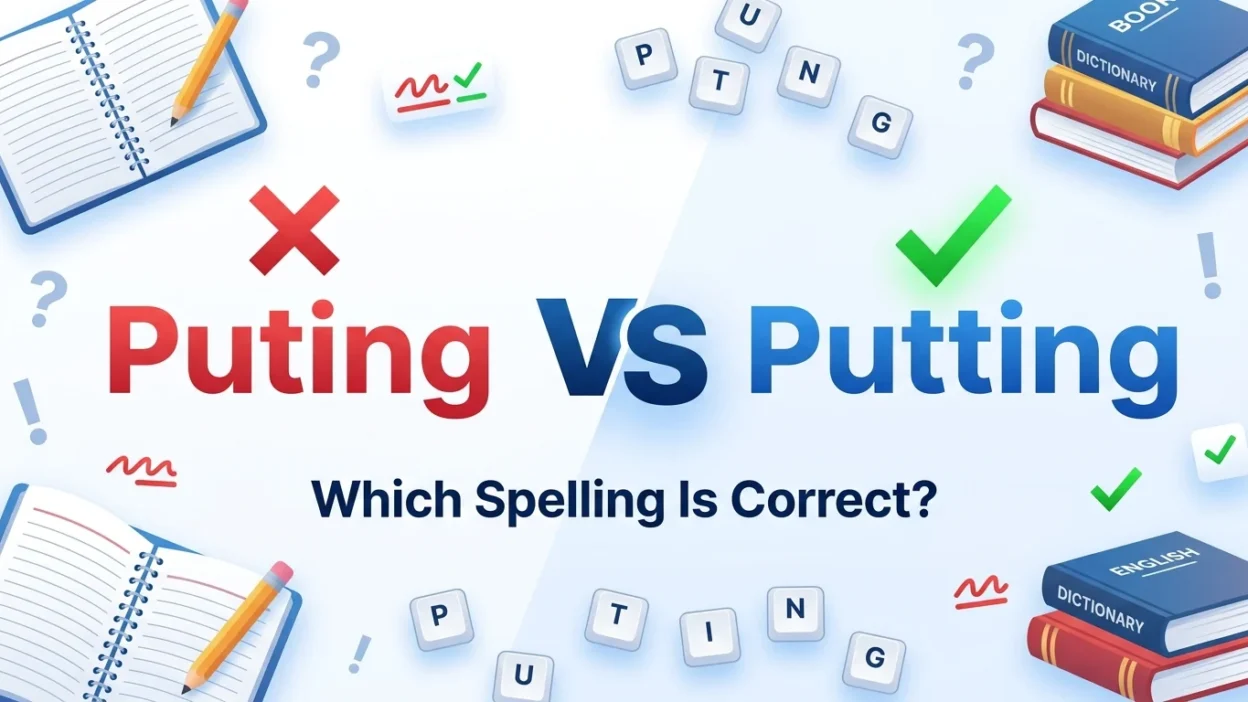
Putting is the correct spelling.
Puting is incorrect and should not be used in standard English writing.
✅ Correct: I am putting the books on the shelf.
❌ Incorrect: I am puting the books on the shelf.
When adding -ing to the verb put, the final consonant t is doubled, resulting in putting.
What Does Putting Mean?
Putting is the present participle and gerund form of the verb put.
The verb put means:
- To place something somewhere
- To set or position an object
- To express or state something
- To cause someone or something to be in a particular condition
Examples of Putting
- She is putting the groceries in the refrigerator.
- They are putting new furniture in the office.
- I am putting extra effort into this project.
- The teacher is putting the assignments online.
In all of these examples, putting describes an ongoing action.
What Does Puting Mean?
Puting is not considered a correct English spelling of the verb put.
It is usually a spelling mistake caused by forgetting to double the final consonant before adding -ing.
Incorrect Examples
- I am puting my phone on the table.
- She is puting on her jacket.
- They are puting together a presentation.
Correct Versions
- I am putting my phone on the table.
- She is putting on her jacket.
- They are putting together a presentation.
Puting vs Putting: The Main Difference
The difference is simple:
| Word | Correct? | Meaning |
|---|---|---|
| Putting | Yes | Present participle of “put” |
| Puting | No | Misspelling of “putting” |
Whenever you’re referring to the action of placing, positioning, arranging, or setting something, putting is the correct form.
Why Is Putting Spelled with Two Ts?
English follows a common spelling rule for many short verbs.
When a verb:
- Has one syllable
- Ends in a single consonant
- Has a short vowel sound before the consonant
The final consonant is often doubled before adding -ing.
Examples
| Base Verb | Correct -ing Form |
|---|---|
| Put | Putting |
| Sit | Sitting |
| Run | Running |
| Get | Getting |
| Stop | Stopping |
The same rule applies to put, which becomes putting, not puting.
Understanding the Double-Consonant Rule
One reason people struggle with puting vs putting is that English contains exceptions.
However, for short verbs like put, the rule is consistent.
Formula
Short verb + final consonant = double consonant + ing
Examples:
- Put → Putting
- Run → Running
- Sit → Sitting
- Hug → Hugging
- Swim → Swimming
Learning this pattern makes it easier to spell many English verbs correctly.
Common Situations Where “Putting” Is Used
The word putting appears in everyday conversations and writing.
Physical Placement
- He is putting the dishes away.
- We are putting decorations on the wall.
Effort and Work
- She is putting a lot of effort into her studies.
- The team is putting energy into the new project.
Communication
- I’m putting my thoughts into writing.
- The manager is putting the proposal together.
Organization
- They are putting files into folders.
- We are putting the plan into action.
These examples show how versatile the word putting can be.
Common Mistakes People Make
Understanding common errors can help you avoid them.
Mistake 1: Writing Puting
This is the most common mistake.
❌ Puting
✅ Putting
Always double the t.
Mistake 2: Assuming Short Verbs Don’t Need Doubling
Some learners incorrectly believe that adding -ing simply means attaching the suffix.
For example:
❌ Put + ing = Puting
The correct form is:
✅ Put + ting = Putting
Mistake 3: Inconsistent Spelling
Using different spellings in the same document can reduce professionalism.
Example:
❌ We are putting together a report and puting the data into charts.
✅ We are putting together a report and putting the data into charts.
Putting in Grammar
In grammar, putting can function as either:
Present Participle
Used with helping verbs.
Examples:
- She is putting the books away.
- They were putting up a tent.
Gerund
Used as a noun.
Examples:
- Putting things off causes stress.
- Putting customers first builds trust.
Recognizing these roles helps improve writing and sentence structure.
Putting vs Other Similar Verb Forms
Many verbs follow the same spelling pattern as putting.
| Verb | Correct Form |
|---|---|
| Put | Putting |
| Sit | Sitting |
| Run | Running |
| Stop | Stopping |
| Get | Getting |
| Begin | Beginning |
Studying similar words reinforces the spelling rule.
American vs British English
Unlike some spelling differences in English, puting vs putting is not an American versus British English issue.
American English
Uses putting.
British English
Also uses putting.
There is no regional variation here.
Whether you’re writing for an audience in the United States, United Kingdom, Canada, Australia, or elsewhere, putting is the correct spelling.
Tips to Remember the Correct Spelling
Here are a few simple memory tricks.
Remember the Double T
Think:
Put → Put-Ting
The extra t helps form the correct word.
Compare with Similar Words
- Sit → Sitting
- Run → Running
- Get → Getting
Since these words double their final consonants, put does too.
Use Spell Check
Most writing tools immediately flag puting as a spelling error.
Read the Word Aloud
“Putting” naturally sounds like it contains two t sounds, making the correct spelling easier to remember.
Examples of Putting in Sentences
Here are additional examples showing proper usage.
- I’m putting the keys on the counter.
- She’s putting together a business proposal.
- They’re putting new software on all company computers.
- We’re putting our plans into motion.
- He keeps putting off important decisions.
- The chef is putting fresh herbs into the soup.
- The team is putting customer satisfaction first.
These examples reflect real-world usage in both formal and informal communication.
Frequently Asked Questions
Is puting a real word?
No. Puting is generally considered a misspelling of putting in standard English.
Which spelling is correct: puting or putting?
Putting is the correct spelling.
Why does putting have two Ts?
English spelling rules require doubling the final consonant in short verbs like put before adding -ing.
Is putting used in both American and British English?
Yes. Both American and British English use putting.
Can putting be used as a noun?
Yes. As a gerund, putting can function as a noun.
Example: Putting others first is a valuable quality.
What is the present participle of put?
The present participle of put is putting.
Why do people write puting?
Many people mistakenly apply a simplified spelling rule and forget to double the final consonant.
Are there other verbs like put?
Yes. Examples include:
- Run → Running
- Sit → Sitting
- Stop → Stopping
- Get → Getting
Summary
When comparing puting vs putting, the answer is straightforward: putting is the only correct spelling in modern English. It serves as both the present participle and gerund form of the verb put, and it follows a common spelling rule that requires doubling the final consonant before adding ing.
Although puting is a frequent mistake, it is not accepted in standard English writing. Whether you’re writing an email, academic paper, blog post, business document, or social media update, using putting ensures your writing appears polished, accurate, and professional.

Jhon Thomson is a creative content writer at NickHive, specializing in usernames and nickname ideas. He enjoys exploring name trends, online identity culture, and branding inspiration. With a passion for digital creativity, Jhon helps readers discover unique, stylish, and meaningful names for social media, gaming, and personal branding.