Have you ever paused while writing and wondered whether it should be scary or scarry? You’re not alone. This is one of the most common English spelling mistakes because the words look so similar, yet only one is considered correct in standard English.
If you’re writing an email, social media post, academic paper, or blog article, using the correct spelling helps improve clarity and credibility. In this guide, you’ll learn the difference between scary vs scarry, discover why people confuse them, see practical examples, and avoid this common mistake forever.
Quick Answer
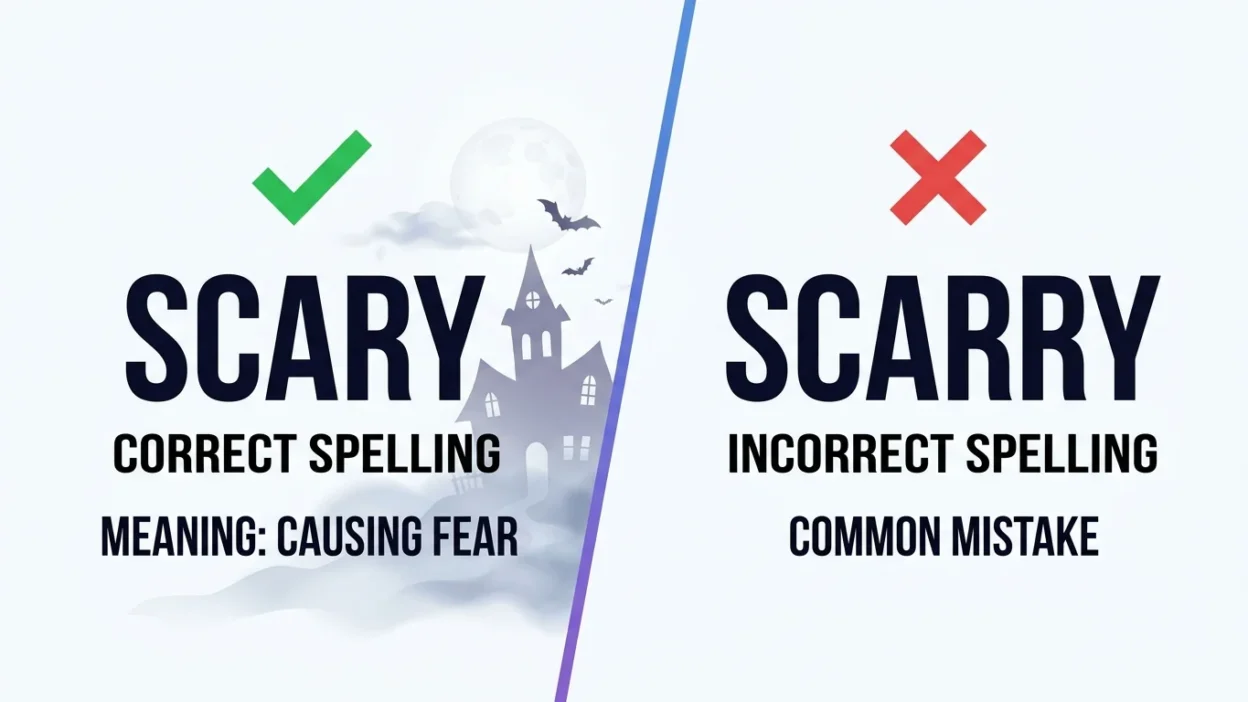
Scary is the correct spelling.
✅ Correct: That movie was scary.
❌ Incorrect: That movie was scarry.
The word scary means something that causes fear, fright, or anxiety. The spelling scarry is generally considered a misspelling and is not recognized as a standard English word.
What Does “Scary” Mean?
The adjective scary describes something that makes people feel afraid, nervous, frightened, or uneasy.
Definition
Scary (adjective): Causing fear or alarm; frightening.
Examples of Scary in Sentences
- The abandoned house looked scary at night.
- My little brother finds thunderstorms scary.
- That horror movie was so scary that I couldn’t sleep.
- Speaking in front of a large audience can be scary.
- The roller coaster looked scary, but it was actually fun.
The word is commonly used in both formal and informal English and appears frequently in everyday conversation.
Is “Scarry” a Real Word?
In modern standard English, scarry is not considered a correct spelling.
Most dictionaries do not recognize scarry as a valid word. When people write it, they usually mean scary but mistakenly add an extra “r.”
Why Do People Write “Scarry”?
Several factors contribute to this spelling error:
- Confusion about double consonants
- Fast typing on phones or keyboards
- Lack of familiarity with English spelling patterns
- Influence from other words that use double letters
Because many English words double consonants before adding suffixes, writers sometimes assume scary should follow the same pattern.
Scary vs Scarry: Side-by-Side Comparison
| Feature | Scary | Scarry |
|---|---|---|
| Correct spelling | ✅ Yes | ❌ No |
| Dictionary recognized | ✅ Yes | ❌ No |
| Meaning | Causing fear or fright | Not a standard English word |
| Used in formal writing | ✅ Yes | ❌ No |
| Used in academic writing | ✅ Yes | ❌ No |
| Recommended usage | Always | Never |
The comparison is simple: use scary, avoid scarry.
Why Is “Scary” Spelled With One R?
Understanding the word’s origin can make the spelling easier to remember.
The word scary comes from the verb scare.
- Scare → Scary
- Scare → Scared
- Scare → Scaring
Since the root word already contains a single “r,” adding the suffix “-y” creates scary, not scarry.
Easy Memory Trick
Think of it this way:
Scare + Y = Scary
There is only one “r” in scare, so there should only be one “r” in scary.
Common Mistakes When Using Scary
Many learners make similar spelling mistakes. Here are some examples:
Incorrect
- The haunted forest was scarry.
- That’s a really scarry story.
- Flying can be scarry for some people.
Correct
- The haunted forest was scary.
- That’s a really scary story.
- Flying can be scary for some people.
A quick spell-check usually catches this mistake, but it’s still worth learning the correct form.
Examples of Scary in Different Contexts
Everyday Conversations
- That dog sounded scary when it barked.
- The dark alley looked scary.
Entertainment
- I love scary movies during Halloween.
- The book had several scary scenes.
Personal Experiences
- Taking my first driving test was scary.
- Moving to a new city felt scary at first.
Workplace Situations
- Giving a presentation to executives can be scary.
- Major career changes often feel scary before they become exciting.
These examples show how versatile the word is across different situations.
Similar Words Often Confused With Scary
Writers sometimes mix up scary with other fear-related words.
Scary vs Frightening
- Scary is more conversational.
- Frightening is often slightly more formal.
Example:
- The movie was scary.
- The movie was frightening.
Both are correct, but the tone differs slightly.
Scary vs Terrifying
- Scary indicates fear.
- Terrifying suggests extreme fear.
Example:
- The thunderstorm was scary.
- The earthquake was terrifying.
Scary vs Creepy
- Scary directly causes fear.
- Creepy creates an unsettling feeling.
Example:
- The monster was scary.
- The old doll looked creepy.
American vs British English: Is There Any Difference?
Good news: there is no difference between American and British English when it comes to this word.
American English
✅ Scary
British English
✅ Scary
Both varieties use exactly the same spelling and meaning.
Whether you’re writing for readers in the United States, United Kingdom, Canada, Australia, or elsewhere, scary remains the correct choice.
Why Correct Spelling Matters
Some people wonder whether a small spelling mistake really matters.
The answer is yes.
Using the correct spelling:
- Improves readability
- Builds credibility
- Creates a professional impression
- Helps search engines understand content
- Prevents confusion among readers
Even a simple error like writing scarry instead of scary can make writing appear less polished.
How to Remember the Correct Spelling
Here are a few simple techniques:
Connect It to the Root Word
Remember:
Scare → Scary
Since scare contains one “r,” scary does too.
Read It Aloud
Pronouncing the word slowly can help reinforce the correct spelling.
Use Spell-Checking Tools
Modern writing tools typically flag scarry as incorrect.
Practice Through Writing
Write a few sentences using scary correctly:
- Spiders are scary to some people.
- The movie was scary but entertaining.
- Walking alone at night can feel scary.
Repeated usage helps build confidence.
Frequently Asked Questions (FAQs)
1. Is it scary or scarry?
Scary is the correct spelling. Scarry is a misspelling.
2. Is scarry in the dictionary?
Most standard English dictionaries do not recognize scarry as a valid word.
3. Why do people spell scary as scarry?
People often assume the word needs a double “r” because many English words contain doubled consonants.
4. Can I use scarry in formal writing?
No. Always use scary in formal, academic, professional, and casual writing.
5. Is scary an adjective?
Yes. Scary is an adjective that describes something that causes fear.
6. What is the noun form of scary?
There is no direct noun form of scary. Related nouns include fear, fright, and terror.
7. Is scary used in British English?
Yes. Both British and American English use the spelling scary.
8. What is another word for scary?
Common synonyms include:
- Frightening
- Terrifying
- Alarming
- Chilling
- Horrifying
- Spine-chilling
- Fearsome
Summary
When comparing scary vs scarry, the answer is straightforward: scary is the only correct spelling in modern English. It refers to something that causes fear, anxiety, or nervousness, while scarry is simply a spelling mistake that should be avoided in all forms of writing.
The easiest way to remember the correct form is to think of the root word scare. Since scare contains just one “r,” the adjective becomes scary, not scarry. Whether you’re writing a text message, business email, academic paper, or blog post, using the correct spelling helps you communicate more clearly and professionally.

Jhon Thomson is a creative content writer at NickHive, specializing in usernames and nickname ideas. He enjoys exploring name trends, online identity culture, and branding inspiration. With a passion for digital creativity, Jhon helps readers discover unique, stylish, and meaningful names for social media, gaming, and personal branding.