If you have ever paused while writing and wondered whether to use “storys” or “stories,” you’re not alone. This is one of the most common English spelling questions, especially for students, writers, and English learners. At first glance, both words may seem reasonable, but only one follows standard English grammar rules.
Understanding the difference is important because using the correct plural form makes your writing look polished, professional, and grammatically accurate. In this guide, you’ll learn which spelling is correct, why the rule exists, common mistakes to avoid, and plenty of examples to help you remember it forever.
Quick Answer
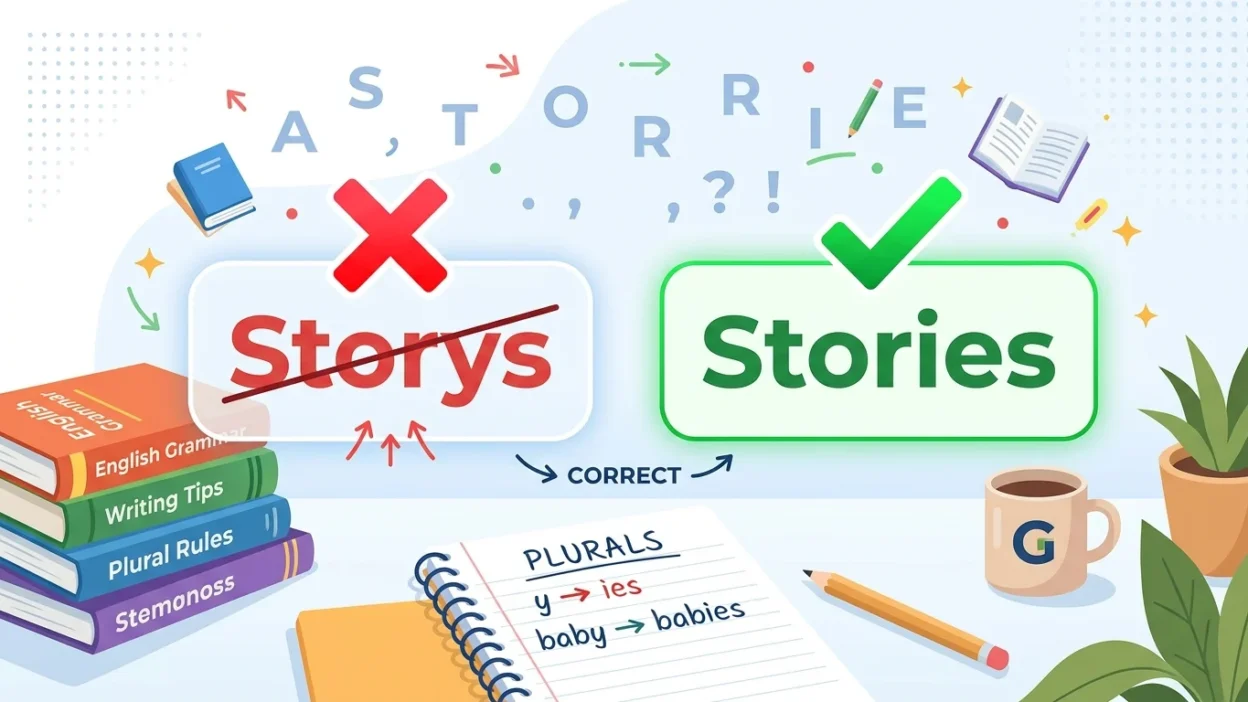
The correct plural form of story is stories.
- ✅ Stories = Correct
- ❌ Storys = Incorrect
When a noun ends in a consonant followed by y, the y changes to ies to form the plural.
Example:
- One story
- Two stories
Therefore, stories is always the correct plural spelling.
What Does “Story” Mean?
Before discussing the plural form, let’s understand the meaning of the word story.
A story is a narrative, account, tale, or description of events. It can be fictional or based on real-life experiences.
Examples:
- She told an interesting story about her childhood.
- The book contains a powerful story of friendship.
- News websites publish stories every day.
The word can also refer to a level or floor in a building.
Example:
- The office is on the third story of the building.
In both meanings, the plural form remains stories.
Why Is “Stories” Correct?
English follows specific spelling rules when forming plurals.
The Rule
When a noun ends with:
- A consonant + y
Change the y to ies and add it to form the plural.
Examples:
| Singular | Plural |
|---|---|
| Story | Stories |
| Baby | Babies |
| City | Cities |
| Lady | Ladies |
| Country | Countries |
Because story ends with the consonant r followed by y, the correct plural becomes stories.
Why Is “Storys” Incorrect?
The spelling storys does not follow English pluralization rules.
Many people assume they can simply add s to any noun, but words ending in a consonant + y are an exception.
Incorrect Examples:
- ❌ Three storys were published today.
- ❌ I love reading adventure storys.
Correct Examples:
- ✅ Three stories were published today.
- ✅ I love reading adventure stories.
Using storys may make your writing appear careless or grammatically incorrect.
Storys or Stories: Comparison Table
| Feature | Stories | Storys |
|---|---|---|
| Correct English spelling | Yes | No |
| Accepted in dictionaries | Yes | No |
| Standard plural of story | Yes | No |
| Used in professional writing | Yes | No |
| Used in academic writing | Yes | No |
| Grammatically correct | Yes | No |
The table makes it clear: stories is the only correct plural form.
Examples of Stories in Sentences
Seeing words in context helps reinforce learning.
Everyday Conversation
- My grandfather tells amazing stories.
- Children enjoy bedtime stories.
- We shared funny stories during dinner.
Academic Writing
- The book contains several historical stories.
- Researchers collected stories from local communities.
Business and Marketing
- Customer success stories can build trust.
- The company published stories about employee achievements.
Journalism
- The newspaper featured stories about the event.
- Reporters covered several breaking stories.
The Plural Rule Explained in Simple Terms
A helpful way to remember the rule is to look at the letter before y.
If a consonant comes before y:
Change y to ies.
Examples:
- Story → Stories
- Family → Families
- Party → Parties
- Cherry → Cherries
If a vowel comes before y:
Simply add s.
Examples:
- Toy → Toys
- Boy → Boys
- Key → Keys
- Day → Days
Since story has r before y, it becomes stories.
Common Mistakes People Make
Many learners struggle with plural nouns ending in y.
Mistake 1: Adding Only S
- ❌ Storys
- ✅ Stories
Mistake 2: Mixing Similar Rules
Some writers confuse words ending in vowels with those ending in consonants.
For example:
- Boy → Boys ✔
- Story → Stories ✔
The rules are different.
Mistake 3: Autocorrect Dependence
People often rely on spell-check tools instead of understanding the grammar rule. Learning the rule helps even when technology is unavailable.
Mistake 4: Using Incorrect Forms in Professional Writing
Misspellings like storys can reduce credibility in:
- Blog posts
- Academic papers
- Business reports
- Marketing content
- Social media captions
Related Words That Follow the Same Rule
Learning similar words can make the rule easier to remember.
Singular to Plural Examples
| Singular | Plural |
|---|---|
| Story | Stories |
| City | Cities |
| Baby | Babies |
| Country | Countries |
| Lady | Ladies |
| Party | Parties |
| Family | Families |
| Fly | Flies |
Notice how all these words replace y with ies.
American vs British English Differences
When comparing storys or stories, there is no difference between American and British English.
Both varieties use:
- ✅ Stories
- ❌ Storys
Unlike spelling variations such as:
- Color (American English)
- Colour (British English)
The plural of story remains stories everywhere.
Whether you are writing in the United States, the United Kingdom, Canada, Australia, or elsewhere, stories is always correct.
Tips to Remember the Correct Spelling
Here are a few simple memory tricks.
Remember the Y Rule
If a word ends in:
Consonant + y
Change y to ies.
Think of Similar Words
Remember:
- Baby → Babies
- City → Cities
- Story → Stories
The same pattern applies.
Read More Often
Reading books, articles, and newspapers exposes you to correct spelling repeatedly, making mistakes less likely.
Use the Sentence Test
Ask yourself:
Would I write “citys”?
Probably not.
Since cities is correct, stories follows the same rule.
FAQs About Storys or Stories
1. Is storys a real word?
No. Storys is not considered a correct English word and is not accepted as the plural form of story.
2. What is the plural of story?
The correct plural form is stories.
3. Why does story become stories?
Because story ends with a consonant followed by y, English grammar changes the y to ies when forming the plural.
4. Is stories correct in American English?
Yes. Stories is correct in both American and British English.
5. Can I use storys in informal writing?
No. Even in casual writing, storys is considered a spelling mistake.
6. What is the difference between story and stories?
Story refers to one narrative or account, while stories refers to more than one.
7. Does story have any other meaning?
Yes. It can also mean a floor or level of a building.
8. How can I remember the correct plural?
Remember the simple rule: consonant + y becomes ies. Therefore, story becomes stories.
Summary
The debate over storys or stories has a straightforward answer: stories is the only correct plural form of story. English grammar requires nouns ending in a consonant followed by y to change the y into ies when becoming plural. That is why we write stories, not storys.
Whether you are writing fiction, academic content, business documents, news articles, or social media posts, using the correct spelling helps communicate clearly and professionally. By remembering the simple consonant plus y rule and practicing with similar words like cities, babies, and families, you’ll never have to second-guess the plural form of story again.

Will Jack is a passionate content creator at NickHive, focused on crafting unique username and nickname ideas. He explores digital identity trends, gaming aliases, and social media branding styles. With a creative mindset and research-driven approach, Will helps readers discover catchy, memorable, and personalized names for every platform.