In everyday writing, the topic seak vs seek often creates confusion, especially during fast typing, where language, paused, many, online, misspellings, common, correct, sound, email, message, wondering, is, it, are, alone, this, point, of, for, english, writers, the, two, words, identical, or, from, people, trying, out, one, usually, boils, down, fact, these, other, mistake, to, a, which, frequent all mix together in real usage. The keyword “seak vs seek” appears here naturally while explaining how writers get stuck when words look identical in quick writing flow and online searches, often asking if it is correct or just a mistake caused by typing speed and attention gaps.
In real have, ever, been moments while writing, I often try to figure why workhorse, simple, not, leads, searches in english usage still causes doubt among writers, especially when words look identical in fast typing situations.
The confusion mainly grows because both forms feel similar when typed quickly, even though one is accepted in standard English and the other is not used in correct writing contexts.
Quick Answer
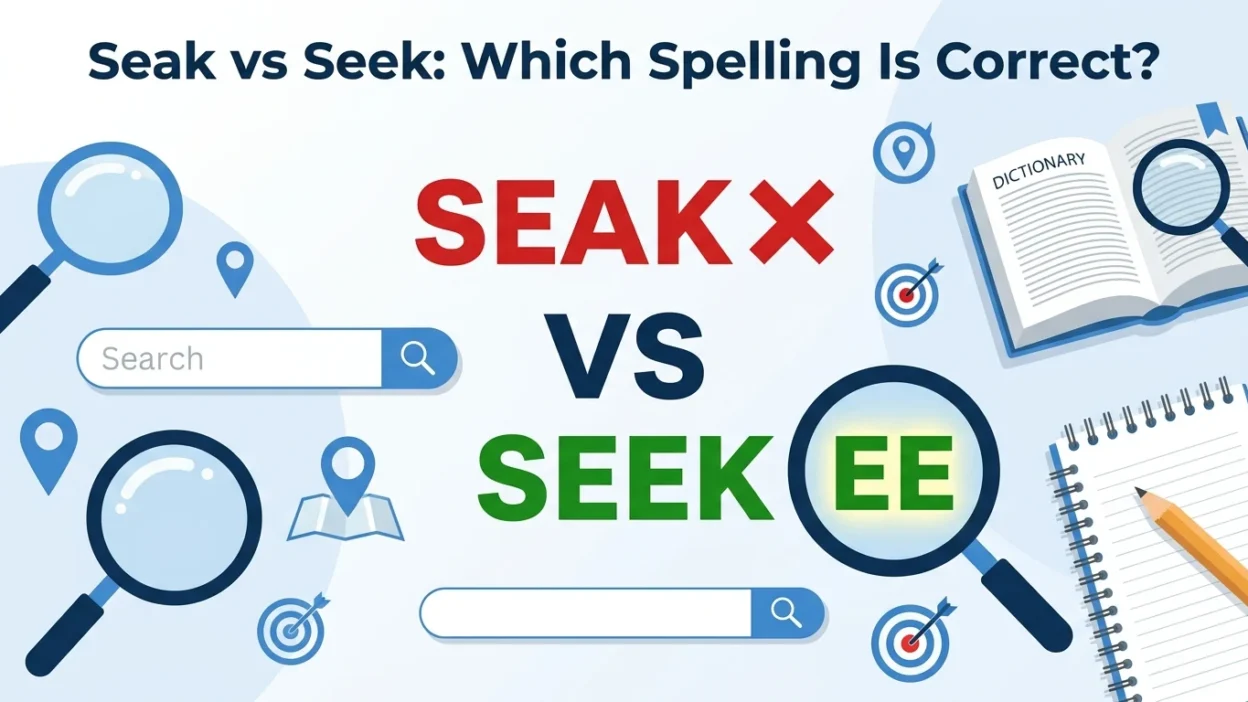
Seek is the correct spelling.
- ✅ Seek = To look for, search for, or try to obtain something.
- ❌ Seak = Incorrect spelling (not a standard English word).
Examples
- I will seek help from a teacher.
- They are trying to seek justice.
- ❌ I will seak help from a teacher.
In standard English, always use seek.
What Does “Seek” Mean?
The word seek is a verb that means to look for something or try to find it. It is commonly used in both formal and informal English.
It can refer to:
- Searching for something physically
- Trying to obtain something abstract (like knowledge or help)
- Making an effort toward a goal
- Requesting assistance or advice
Examples of Seek in Sentences
- She decided to seek medical advice.
- They seek opportunities abroad.
- Many students seek scholarships.
- The company is seeking new investors.
- He went to the city to seek employment.
The word is widely used in academic, business, legal, and everyday communication.
Is “Seak” a Real Word?
No.
Seak is not recognized as a correct English word in any standard dictionary. It is simply a misspelling of seek.
Why Does the Mistake Happen?
The confusion usually comes from:
- Similar pronunciation (both sound identical)
- Typing errors
- Lack of exposure to written English
- Overgeneralization of spelling patterns
Incorrect Examples
❌ I want to seak advice.
❌ They seak better opportunities.
Correct Examples
✅ I want to seek advice.
✅ They seek better opportunities.
Seak vs Seek: Side-by-Side Comparison
| Feature | Seak | Seek |
|---|---|---|
| Correct spelling | ❌ No | ✅ Yes |
| Found in dictionary | ❌ No | ✅ Yes |
| Meaning | None | To search or look for |
| Used in formal writing | ❌ No | ✅ Yes |
| Academic usage | ❌ No | ✅ Yes |
| Common English word | ❌ No | ✅ Yes |
This comparison makes it clear that seek is the only valid form.
Meaning and Usage of Seek
The verb seek is versatile and appears in many contexts.
1. Seeking Information or Help
- I seek guidance from my mentor.
- They seek information about the project.
2. Seeking Opportunities
- Graduates often seek jobs abroad.
- Investors seek profitable ventures.
3. Seeking Solutions
- Scientists seek cures for diseases.
- Engineers seek better designs.
4. Seeking Abstract Goals
- People seek happiness.
- Many seek peace and stability.
Forms of the Word Seek
The verb seek changes depending on tense:
- Present: seek
- Past: sought
- Present participle: seeking
- Third person: seeks
Examples
- I seek advice.
- I sought advice yesterday.
- I am seeking advice.
- She seeks guidance regularly.
Notice that seak never appears in any form.
Common Mistakes People Make
Mistake #1: Spelling It as Seak
❌ He will seak help.
✅ He will seek help.
Mistake #2: Confusing Seek with See
Some learners confuse the meanings:
- see = to visually observe
- seek = to look for or search
Incorrect assumption:
❌ I see help.
Correct:
✅ I seek help.
Mistake #3: Relying on Sound Instead of Spelling
Since both words sound the same, writers often depend on pronunciation instead of correct spelling rules.
Mistake #4: Assuming Seak is an Alternative Spelling
Some users mistakenly believe “seak” is an older or British version. This is incorrect.
Why Seek Is the Correct Form
English spelling often follows historical roots. The word seek comes from Old English sēcan, meaning “to search for or request.”
Over time, the spelling evolved into the modern form:
- Old English: sēcan
- Middle English: seken
- Modern English: seek
The spelling seak never existed in standard usage.
American vs British English
There is no difference in spelling between American and British English for this word.
American English
- Seek ✅
- Seak ❌
British English
- Seek ✅
- Seak ❌
Both varieties use the same correct spelling.
Examples of Seek in Real-Life Contexts
Everyday Usage
- I need to seek advice from my parents.
- She decided to seek a new path in life.
Business Communication
- The company is seeking new partnerships.
- We seek innovative solutions for growth.
Academic Writing
- Researchers seek to understand climate change.
- Students seek knowledge through study.
Legal Context
- The plaintiff will seek compensation.
- The lawyer plans to seek justice in court.
Common Phrases Using Seek
The word appears in many expressions:
Seek Help
Meaning: ask for assistance
- Don’t hesitate to seek help when needed.
Seek Advice
Meaning: request guidance
- She sought advice from a mentor.
Seek Opportunities
Meaning: look for chances to succeed
- Many graduates seek opportunities abroad.
Seek Approval
Meaning: request permission or agreement
- Employees must seek approval before changes.
Seek Justice
Meaning: pursue fairness through legal means
- The victim seeks justice in court.
Memory Tricks to Remember the Correct Spelling
Trick #1: Think of “Seek = Search”
Both start with SE:
- SEek = SEarch
Trick #2: Double E Reminder
The double “ee” in seek represents “looking closely.”
Trick #3: Connect With “See”
- see = observe
- seek = search for what you want to see
Trick #4: Remember the Rule
If it sounds like “see + k,” it is:
- seek ✅
- seak ❌
Related Keywords and LSI Terms
When learning about seak vs seek, related concepts include:
- English spelling rules
- Common spelling mistakes
- Frequently confused words
- Verb usage
- Search synonyms
- Grammar correction
- Writing accuracy
- Vocabulary building
- English language learning
- Proper spelling guide
These related terms help improve understanding and writing clarity.
Frequently Asked Questions
Is seak a correct English word?
No. Seak is not a valid English word.
Which is correct, seak or seek?
Seek is correct.
What does seek mean?
It means to look for, search for, or try to obtain something.
Why do people write seak instead of seek?
Because both words sound the same, leading to spelling confusion.
Is seek used in formal writing?
Yes. It is commonly used in academic, business, and legal writing.
What is the past tense of seek?
The past tense is sought.
Can seek and see be used interchangeably?
No. They have different meanings:
- see = to observe
- seek = to search
Is there any British vs American spelling difference?
No. Both use seek.
Summary
The confusion between seak vs seek is very common, but the answer is simple: seek is the correct spelling in all forms of English. It means to search for, look for, or try to obtain something, and it is widely used in everyday communication, academic writing, and professional contexts. The spelling seak does not exist in standard English and should always be avoided.
Understanding the correct usage of seek improves writing accuracy and helps you communicate more clearly. Since English spelling often relies on historical forms, remembering that seek is derived from older language roots can also help reinforce the correct spelling.
In short, whenever you want to express searching or looking for something, always use seek never seak. This small correction can make your writing more polished, credible, and grammatically correct.

Martin Smith is a creative writer at NickHive, specializing in unique usernames and nickname ideas. He researches online naming trends, gaming identities, and social media branding strategies. With a sharp eye for originality, Martin helps readers craft memorable, stylish, and meaningful names that stand out across digital platforms.