Have you ever typed “offerred” while writing an email or assignment and suddenly wondered if it looks right? You are not alone. Many English learners and even native speakers get confused between “offerred” vs “offered”, especially when dealing with double consonants in past tense verbs.
This confusion is common because English spelling rules can feel inconsistent. However, only one of these forms is correct in standard English, and knowing the difference can instantly improve your writing accuracy, grammar confidence, and professional communication.
Quick Answer
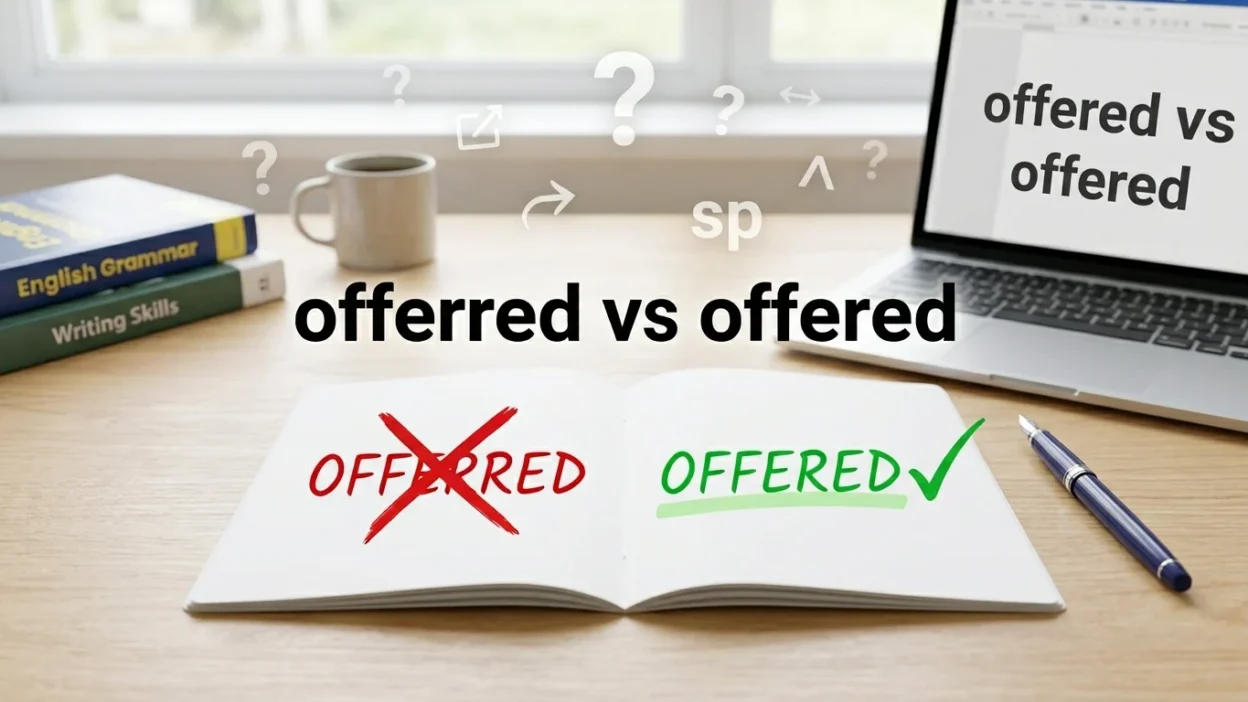
The correct spelling is “offered.”
❌ “offerred” is incorrect and not accepted in standard English.
The word “offered” is the past tense and past participle of the verb “offer,” meaning to present, propose, or give something to someone.
Meaning of Offered in English Grammar
The word offered comes from the base verb “offer,” which is widely used in everyday communication, business writing, academic English, and formal speech.
Definition of Offered:
Offered (verb, past tense): to present something for acceptance, rejection, or consideration.
Common meanings include:
- To propose help or support
- To present a job, opportunity, or service
- To give something voluntarily
- To make a suggestion or invitation
Examples in sentences:
- She offered me a cup of tea when I arrived.
- The company offered him a better salary package.
- They offered support during the crisis.
- He offered an explanation for his absence.
Why “Offerred” Is Incorrect
The spelling “offerred” is a common mistake caused by misunderstanding English doubling rules. Some verbs double the final consonant before adding “-ed,” but offer is not one of them.
Correct rule:
When a verb ends in a consonant + “er,” you usually do not double the “r” before adding “-ed.”
So:
- offer → offered ✔
- confer → conferred ✔ (exception pattern due to stress rules)
- prefer → preferred ✔ (stress-based doubling rule)
But:
- offer → offerred ❌ (wrong spelling)
The extra “r” in “offerred” is unnecessary and makes the word incorrect in standard English grammar.
Offerred vs Offered: Key Comparison Table
| Feature | Offered | Offerred |
|---|---|---|
| Correct spelling | Yes | No |
| Accepted in dictionaries | Yes | No |
| Grammar usage | Past tense of “offer” | Incorrect form |
| Common in writing | Yes | Common mistake |
| Formal communication | Appropriate | Not acceptable |
| English standard | American & British | Not recognized |
Common Reasons People Write “Offerred”
Understanding why this mistake happens helps you avoid it in the future. Here are the most common causes:
1. Overgeneralizing spelling rules
Many learners assume all verbs ending in “-er” double the “r” before adding “-ed,” which is not true.
2. Influence of similar words
Words like “preferred” and “conferred” confuse learners because they do use double letters.
3. Typing habits
Fast typing or autocorrect errors can unintentionally produce “offerred.”
4. Lack of exposure
If you mostly read informal writing or unedited content, incorrect forms may appear familiar.
Simple Grammar Rule to Remember
A helpful rule to avoid confusion:
👉 If a verb ends in “-er,” it usually does NOT double the “r” before adding “-ed.”
Examples:
- offer → offered ✔
- cover → covered ✔
- deliver → delivered ✔
But stress-based exceptions exist:
- prefer → preferred ✔
- refer → referred ✔
Since “offer” is not stressed on the last syllable, it remains offered.
American vs British English Usage
One important question learners often ask is whether offerred vs offered differs between American and British English.
The truth:
There is no difference between American and British English for this word.
Both varieties use:
- offered ✔
- offerred ❌ (incorrect everywhere)
However, spelling differences do exist in other words (like “colour” vs “color”), but “offered” is universal.
Examples of Correct Usage in Real Contexts
Business English:
- The manager offered a promotion to the employee.
- Our company offered free consultation services.
Academic English:
- The professor offered additional guidance before the exam.
- The study offered new insights into climate change.
Everyday English:
- My friend offered me a ride home.
- She offered to help with homework.
Formal writing:
- The organization offered humanitarian aid to the affected region.
Common Mistakes Related to “Offered”
Many learners also make related errors when using this verb:
1. Wrong spelling
- ❌ offerred
- ✔ offered
2. Incorrect tense confusion
- ❌ He offer me help yesterday
- ✔ He offered me help yesterday
3. Wrong participle usage
- ❌ He has offerred support
- ✔ He has offered support
4. Missing auxiliary verbs
- ❌ She offered going to the meeting
- ✔ She offered to go to the meeting
Tips to Remember the Correct Spelling
Here are simple memory tricks to help you always choose the correct form:
✔ Think “offer + ed = offered”
Just add “-ed” without doubling letters.
✔ Associate with similar simple verbs:
- cover → covered
- open → opened
- offer → offered
✔ Visual memory trick:
Imagine “offer” giving something away—no need for extra letters.
FAQs about Offerred vs Offered
1. What is the correct spelling: offerred or offered?
The correct spelling is offered. “Offerred” is incorrect.
2. Why do people write offerred?
It usually happens due to confusion with other verbs that double letters, like “preferred.”
3. Is offerred ever used in English?
No, “offerred” is not accepted in any standard English dictionary.
4. Is offered past tense or past participle?
Yes, offered is both the past tense and past participle of “offer.”
5. Does British English use offerred?
No. Both British and American English use offered.
6. How can I avoid spelling mistakes like this?
Learn basic verb spelling rules and practice reading correctly written English.
7. Is “offered” formal or informal?
It is used in both formal and informal writing.
8. What is the base form of offered?
The base form is offer.
Summary
The confusion between offerred vs offered is common, but the correct and standard spelling is always offered. The incorrect form “offerred” comes from misunderstanding English spelling rules, especially when dealing with double consonants in verbs.
By learning the simple rule that “offer” only needs “ed” added without doubling the “r,” you can avoid one of the most frequent spelling mistakes in English writing. This small improvement can make your emails, essays, and professional communication much more accurate and polished.
Understanding correct verb forms like this not only improves grammar but also builds confidence in everyday writing and speaking. Once you master it, you’ll rarely confuse similar words again.

Jhon Thomson is a creative content writer at NickHive, specializing in usernames and nickname ideas. He enjoys exploring name trends, online identity culture, and branding inspiration. With a passion for digital creativity, Jhon helps readers discover unique, stylish, and meaningful names for social media, gaming, and personal branding.