
Have you ever written the past tense of weep and paused to wonder whether it should be weeped or wept? You’re not alone. English contains many irregular verbs that don’t follow standard patterns, and weep is one of them. This confusion often appears in essays, creative writing, social media posts, and everyday communication.
Understanding the difference between weeped or wept can help you write with greater confidence and accuracy. In this guide, you’ll learn the correct form, why one spelling is preferred, common mistakes to avoid, practical examples, and the grammar rule behind this often misunderstood verb.
Quick Answer
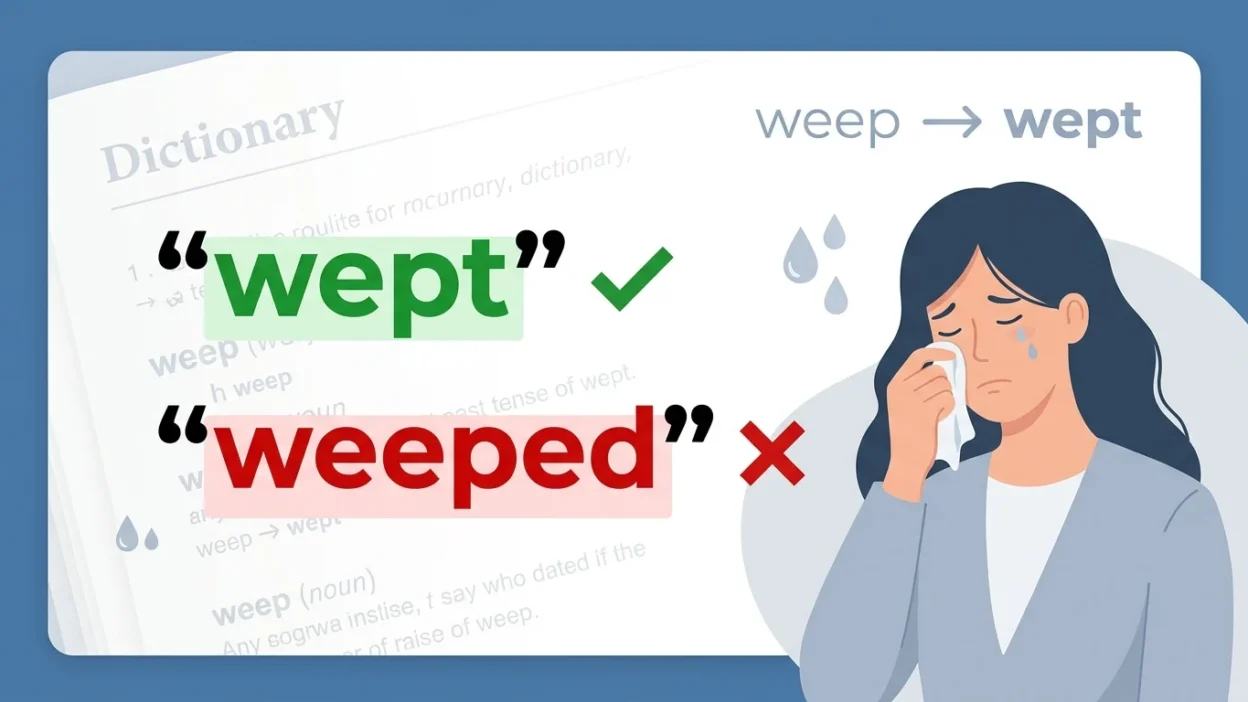
The correct past tense and past participle of weep is wept.
✅ Wept – Correct
❌ Weeped – Incorrect in standard English
Examples:
- She wept when she heard the news.
- They had wept throughout the ceremony.
In modern English, wept is the accepted grammatical form, while weeped is generally considered incorrect.
What Does “Weep” Mean?
The verb weep means to cry, shed tears, or express deep sorrow, grief, sadness, or emotion.
It is often used in literary, formal, or emotional contexts and typically conveys stronger feelings than simply saying “cry.”
Examples:
- The mother began to weep with joy.
- He wept after hearing the heartbreaking story.
- She wept quietly during the memorial service.
Related words and synonyms include:
- Cry
- Sob
- Mourn
- Lament
- Shed tears
- Grieve
- Sorrow
Weeped or Wept: Which One Is Correct?
The correct form is wept.
English has many irregular verbs that do not form the past tense by simply adding -ed.
For example:
- Keep → Kept
- Sleep → Slept
- Weep → Wept
Because weep follows this irregular pattern, wept is the proper past tense and past participle.
Comparison Table
| Form | Correct? | Usage |
|---|---|---|
| Weep | ✅ Yes | Present tense |
| Wept | ✅ Yes | Past tense and past participle |
| Weeped | ❌ No | Incorrect standard English |
| Weeping | ✅ Yes | Present participle |
Examples:
- Present: I weep when I watch that movie.
- Past: I wept during the ending.
- Continuous: I am weeping right now.
Why Is Wept Correct?
The word weep belongs to a group of irregular verbs that change internally rather than adding -ed.
Many common English verbs behave this way:
| Present | Past |
|---|---|
| Keep | Kept |
| Sleep | Slept |
| Sweep | Swept |
| Weep | Wept |
These patterns developed historically over centuries and remain part of modern English grammar.
As a result, native speakers and dictionaries recognize wept as the correct form.
Why Do People Write “Weeped”?
The mistake is understandable.
Most English verbs create the past tense by adding -ed:
- Walk → Walked
- Talk → Talked
- Jump → Jumped
Because of this pattern, many learners assume:
- Weep → Weeped
However, English contains numerous exceptions, and weep happens to be one of them.
People often write weeped because:
- They are unfamiliar with irregular verbs.
- They rely on general grammar patterns.
- English is their second language.
- They rarely encounter the word in writing.
While understandable, weeped is not considered standard English.
Examples of Wept in Sentences
Seeing the word in context makes it easier to remember.
Emotional Situations
- She wept after reading the farewell letter.
- The family wept together during the funeral.
- He quietly wept in the hospital waiting room.
Literature and Storytelling
- The princess wept when the kingdom fell.
- The old man wept over memories of his youth.
- The hero wept for those he could not save.
Joy and Relief
- She wept tears of happiness at the reunion.
- They wept with relief after hearing the good news.
These examples demonstrate that wept works naturally in both formal and everyday writing.
Common Mistakes with Weep and Wept
Mistake 1: Using Weeped
❌ She weeped all night.
✅ She wept all night.
Mistake 2: Mixing Tenses
❌ Yesterday, he weep.
✅ Yesterday, he wept.
Mistake 3: Using Wept as Present Tense
❌ Every time I watch that film, I wept.
✅ Every time I watch that film, I weep.
Mistake 4: Incorrect Past Participle
❌ They have weeped for hours.
✅ They have wept for hours.
Avoiding these mistakes improves grammar accuracy and writing professionalism.
Is Weeped Ever Acceptable?
In modern standard English, weeped is generally considered incorrect.
Historically, some older texts occasionally used alternative verb forms, but contemporary dictionaries, style guides, educational institutions, and professional publications overwhelmingly prefer wept.
Therefore:
- Academic writing → Use wept
- Business writing → Use wept
- Creative writing → Use wept
- Formal communication → Use wept
Using weeped may appear as a grammatical error to readers.
American vs British English
One common question is whether American and British English differ on this word.
The answer is no.
Both American English and British English use:
✅ Weep
✅ Wept
Neither variety recognizes weeped as the standard past tense.
Examples:
- American English: She wept after the ceremony.
- British English: She wept after the ceremony.
The spelling and grammar remain identical across both forms of English.
Similar Irregular Verbs
Learning related verbs can help reinforce the pattern.
| Present Verb | Past Tense |
|---|---|
| Weep | Wept |
| Sleep | Slept |
| Keep | Kept |
| Sweep | Swept |
| Creep | Crept |
Notice the recurring -ept pattern.
This makes it easier to remember that:
Weep → Wept
not
Weep → Weeped
Memory Trick for Remembering Wept
Here’s a simple trick:
Think of these word pairs:
- Keep → Kept
- Sleep → Slept
- Sweep → Swept
Now apply the same pattern:
- Weep → Wept
If you can remember kept and slept, you’ll remember wept too.
Many learners find this comparison helpful because the verbs share a similar structure.
Why Correct Usage Matters
Choosing the correct verb form improves:
- Grammar accuracy
- Academic performance
- Professional credibility
- Writing quality
- Reader trust
- Communication clarity
Using wept instead of weeped demonstrates a stronger command of English and helps your writing sound more natural and polished.
Whether you’re writing stories, essays, blog posts, or professional documents, mastering irregular verbs is an important step toward fluent English.
FAQs About Weeped or Wept
1. Is weeped a real word?
While it may occasionally appear in informal usage, weeped is not considered the correct standard past tense of weep.
2. What is the correct past tense of weep?
The correct past tense is wept.
3. What is the past participle of weep?
The past participle is also wept.
Example:
- She has wept many times.
4. Why isn’t weeped correct?
Because weep is an irregular verb that changes to wept rather than adding -ed.
5. Is wept used in American English?
Yes. American English uses wept.
6. Is wept used in British English?
Yes. British English also uses wept.
7. What is the difference between cry and weep?
Both mean shedding tears, but weep often sounds more formal, literary, or emotionally intense.
8. How can I remember the correct form?
Associate it with similar irregular verbs:
- Keep → Kept
- Sleep → Slept
- Weep → Wept
Summary
When comparing weeped or wept, the correct answer is clear: wept is the accepted past tense and past participle of weep. Although many people assume that adding ed creates the past tense, weep follows an irregular pattern similar to keep, sleep, and sweep. As a result, weeped is generally considered incorrect in modern English.
Using wept in your writing ensures grammatical accuracy and helps your communication sound natural, professional, and polished. Whether you’re writing an academic paper, a novel, a blog post, or a personal message, remembering the simple pattern weep wept will help you avoid a common English mistake.

Will Jack is a passionate content creator at NickHive, focused on crafting unique username and nickname ideas. He explores digital identity trends, gaming aliases, and social media branding styles. With a creative mindset and research-driven approach, Will helps readers discover catchy, memorable, and personalized names for every platform.