If you’ve ever typed thier, their, or there and paused to wonder which one is correct, you’re far from alone. These words are among the most commonly confused terms in English because they look and sound similar. A single misplaced letter can completely change the meaning of your sentence.
Whether you’re writing an email, school assignment, blog post, social media update, or business document, understanding the difference between thier vs their vs there can help you communicate more clearly and confidently. In this guide, you’ll learn the meaning of each word, see practical examples, discover common mistakes, and master an easy way to remember the correct usage.
Quick Answer
Here’s the simple answer:
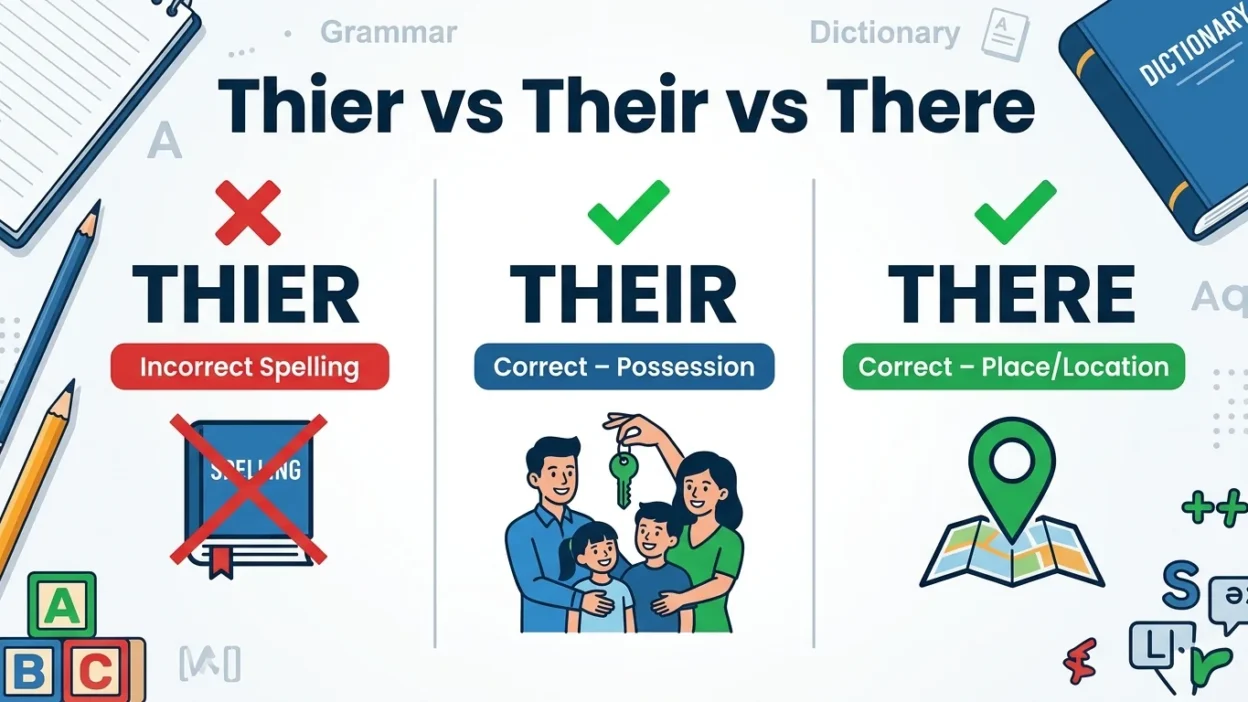
- Their = shows ownership or possession.
- There = refers to a place, location, or existence.
- Thier = incorrect spelling of their.
Examples
✅ Their house is beautiful.
✅ The keys are over there.
❌ Thier house is beautiful.
In standard English, thier is considered a spelling mistake.
Understanding “Their”
Their is a possessive determiner (sometimes called a possessive adjective).
It shows that something belongs to someone.
Meaning of Their
The word their indicates ownership, possession, or association.
Examples of Their
- Their car is parked outside.
- The students submitted their assignments.
- The dogs wagged their tails.
- People should respect their neighbors.
- Sarah and James brought their children to the event.
In each example, their shows who owns or possesses something.
Understanding “There”
There has several grammatical functions.
Most commonly, it refers to a place or location.
Meaning of There
There indicates:
- A location
- A position
- The existence of something
Examples of There as a Location
- The restaurant is over there.
- Please put the box there.
- We met there last week.
Examples of There Showing Existence
- There is a problem with the system.
- There are many books on the shelf.
- There was a storm last night.
In these sentences, there introduces the existence of something.
What Is “Thier”?
Thier is not a correct English word.
It is simply a misspelling of their.
Incorrect Usage
❌ Thier house is large.
❌ I like thier new car.
Correct Usage
✅ Their house is large.
✅ I like their new car.
This mistake usually happens because writers accidentally reverse the letters “e” and “i.”
Thier vs Their vs There: Comparison Table
| Word | Meaning | Correct Usage |
|---|---|---|
| Their | Shows ownership or possession | ✅ Yes |
| There | Refers to a place or existence | ✅ Yes |
| Thier | Misspelling of their | ❌ No |
Remember:
- Their = ownership
- There = location or existence
- Thier = mistake
Why People Confuse These Words
Several factors make these words difficult.
Similar Pronunciation
In many accents, their and there sound nearly identical.
This makes them classic homophones.
Typing Errors
The word thier often appears because people accidentally switch the order of “i” and “e.”
Fast Writing
When typing quickly, writers sometimes focus on sound rather than spelling.
As a result, errors slip through unnoticed.
Easy Trick to Remember Their
One of the easiest memory tricks involves the word itself.
Their Contains “Heir”
An heir inherits possessions.
Since their relates to ownership, remembering “heir” inside their can help.
Example:
- Their books
- Their house
- Their idea
All indicate possession.
Easy Trick to Remember There
Think about the word there as containing here.
There Contains “Here”
Both words relate to places and locations.
Examples:
- Put the package there.
- The school is over there.
- There are several people waiting.
Whenever you’re talking about a place, there is usually the correct choice.
Common Mistakes and Corrections
Let’s look at some frequent errors.
Mistake #1: Using Thier Instead of Their
❌ Thier dog is friendly.
✅ Their dog is friendly.
Mistake #2: Mixing Their and There
❌ There car is parked outside.
✅ Their car is parked outside.
Mistake #3: Using Their for a Location
❌ Put the books on their.
✅ Put the books over there.
Mistake #4: Using There for Possession
❌ There shoes are new.
✅ Their shoes are new.
Understanding the function of each word makes these mistakes much easier to avoid.
Real-Life Examples
In School Writing
Correct:
- The students completed their homework.
- There are twenty students in the classroom.
Incorrect:
- The students completed thier homework.
In Business Emails
Correct:
- The managers reviewed their reports.
- There will be a meeting tomorrow.
In Everyday Conversations
Correct:
- Their family lives nearby.
- We went there last summer.
These examples demonstrate how often these words appear in daily communication.
Their vs There: Side-by-Side Examples
| Sentence | Correct Word |
|---|---|
| ___ laptop is on the desk. | Their |
| Put the bag over ___. | There |
| ___ are many reasons to apply. | There |
| The athletes celebrated ___ victory. | Their |
| We stopped ___ during our trip. | There |
| The children packed ___ lunches. | Their |
Practicing these examples helps reinforce the distinction.
Synonyms and Related Grammar Concepts
While their and there have unique grammatical roles, understanding related concepts can improve overall writing.
- My
- Your
- His
- Her
- Its
- Our
- Their
- Here
- There
- Nearby
- Away
- Above
- Below
- Homophones
- Possessive adjectives
- Determiners
- Pronouns
- Subject-verb agreement
These concepts often appear together in English grammar lessons.
American vs British English
Unlike some words that differ between American and British English, these spellings remain the same.
American English
✅ Their
✅ There
British English
✅ Their
✅ There
Incorrect in Both
❌ Thier
No spelling differences exist between the two varieties of English for these words.
Why Correct Usage Matters
Confusing these words can affect readability and professionalism.
Better Communication
Correct spelling ensures readers understand your intended meaning.
Professional Appearance
Accurate grammar creates a stronger impression in emails, resumes, and reports.
Academic Success
Teachers and professors often mark errors involving homophones.
Credibility
Attention to grammar helps establish trust with readers.
Even a small mistake such as writing thier can distract readers from your message.
Quick Memory Guide
If you’re still unsure, use this simple chart:
Their = Ownership
- Their house
- Their car
- Their opinion
There = Place or Existence
- Go there
- Stand there
- There is a problem
Thier = Wrong
- Always replace it with their
This quick rule solves most confusion instantly.
Frequently Asked Questions (FAQs)
1. Is thier a real word?
No. Thier is a misspelling of their.
2. What is the difference between their and there?
Their shows ownership, while there refers to a location or existence.
3. Why do people write thier?
Most often, it’s a typing error caused by reversing the letters “i” and “e.”
4. Is thier accepted in dictionaries?
No. Standard English dictionaries do not recognize thier as a correct word.
5. How can I remember their and there?
Remember:
- Their contains “heir” and relates to ownership.
- There contains “here” and relates to place.
6. Are their and there homophones?
Yes. They are homophones because they sound similar but have different meanings.
7. Is there a difference between American and British English?
No. Both use their and there with the same spellings and meanings.
8. Which word is correct in “___ house is beautiful”?
The correct word is their because it shows ownership.
Summary
When comparing thier vs their vs there, only their and there are correct English words. Their is used to show possession or ownership, while there refers to a location, position, or the existence of something. The spelling thier is simply a common typo caused by reversing the letters “i” and “e.”
Learning the difference between these words can significantly improve your writing accuracy. A simple memory trick “their contains heir” and “there contains here” can help you choose the correct word quickly. Whether you’re writing professionally, academically, or casually, mastering these commonly confused words will make your communication clearer and more effective.

Will Jack is a passionate content creator at NickHive, focused on crafting unique username and nickname ideas. He explores digital identity trends, gaming aliases, and social media branding styles. With a creative mindset and research-driven approach, Will helps readers discover catchy, memorable, and personalized names for every platform.