If you’ve ever typed havnt or havent and wondered which one is correct, you’re not alone. These spellings frequently appear in text messages, social media posts, emails, and online conversations. Because English contractions can be confusing, many people are unsure whether either form is grammatically correct.
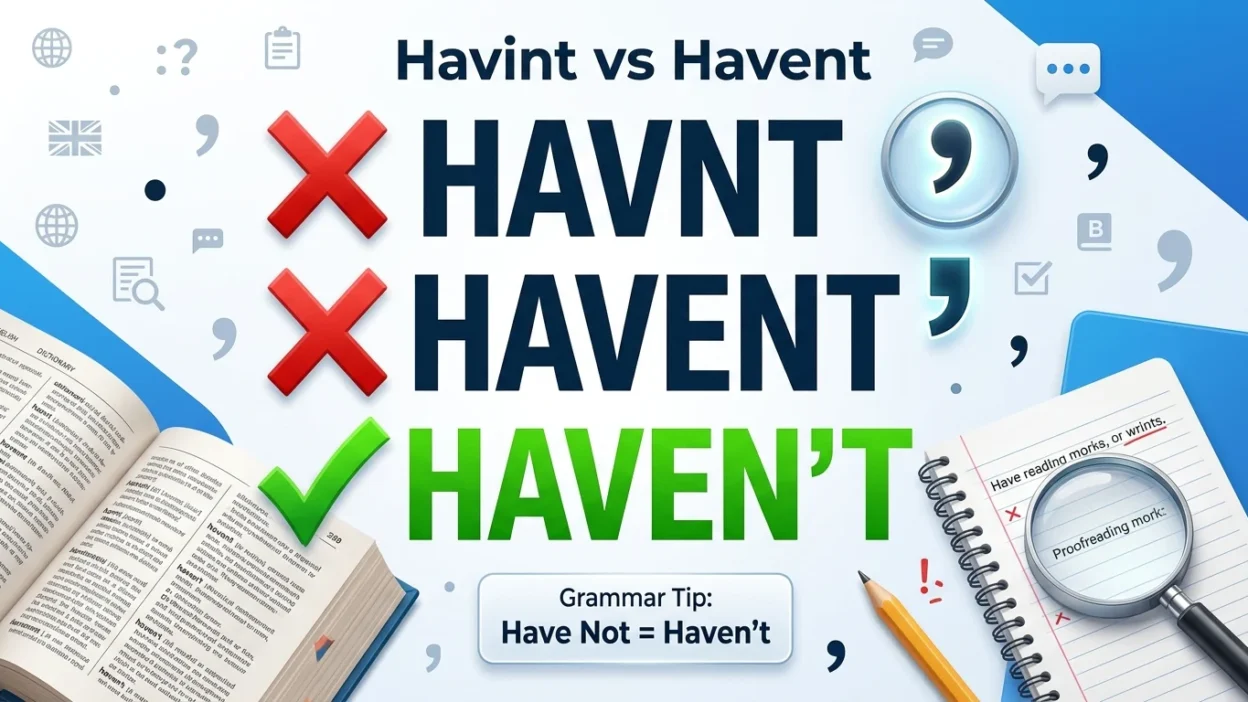
The answer is surprisingly simple. Neither havnt nor havent is considered correct in standard English. The proper contraction is haven’t, which includes an apostrophe. Understanding the difference can help you write more professionally, avoid common grammar mistakes, and improve your overall communication skills.
Quick Answer
Neither havnt nor havent is correct in standard English.
The correct spelling is:
✅ haven’t = contraction of have not
Examples:
✅ I haven’t finished my homework yet.
❌ I havent finished my homework yet.
❌ I havnt finished my homework yet.
Whenever you mean have not, always write haven’t with an apostrophe.
Havnt vs Havent: What’s the Difference?
The key difference is that neither spelling follows standard English grammar rules.
| Word | Correct? | Meaning |
|---|---|---|
| Haven’t | ✅ Yes | Contraction of “have not” |
| Havent | ❌ No | Misspelling of “haven’t” |
| Havnt | ❌ No | Misspelling of “haven’t” |
Many people omit the apostrophe when typing quickly, while others accidentally remove the letter “e,” creating havnt.
However, both forms are considered grammatical errors.
What Does “Haven’t” Mean?
Haven’t is a contraction of the words:
Have + Not = Haven’t
It is commonly used in spoken and written English to express:
- Negation
- Lack of completion
- Absence of experience
- Things that have not happened
Examples of Haven’t
- I haven’t seen that movie.
- We haven’t made a decision yet.
- They haven’t arrived.
- You haven’t answered my question.
- She hasn’t called me today.
In everyday communication, haven’t is one of the most frequently used English contractions.
Why Do People Write “Havent”?
The spelling havent usually appears because people forget to include the apostrophe.
This is especially common when:
- Typing quickly
- Sending text messages
- Posting on social media
- Writing informal chats
Example
❌ I havent finished the report.
✅ I haven’t finished the report.
Although readers usually understand the intended meaning, havent is still considered incorrect in formal and standard written English.
Why Do People Write “Havnt”?
The spelling havnt is another common typo.
It often occurs because:
- Writers omit both the apostrophe and the letter “e”
- Fast typing leads to accidental errors
- Users rely on phonetic spelling
Example
❌ I havnt completed the assignment.
✅ I haven’t completed the assignment.
While havnt may appear online, it is not recognized by dictionaries as a correct English word.
Understanding Contractions in English
To fully understand why haven’t is correct, it helps to know how contractions work.
A contraction combines two words and replaces omitted letters with an apostrophe.
Examples:
| Full Form | Contraction |
|---|---|
| Have not | Haven’t |
| Do not | Don’t |
| Cannot | Can’t |
| Is not | Isn’t |
| Will not | Won’t |
The apostrophe is important because it shows that letters have been omitted.
Without the apostrophe, the word becomes grammatically incorrect.
Examples of Haven’t in Everyday English
Daily Conversations
- I haven’t eaten lunch yet.
- We haven’t met before.
- They haven’t finished the project.
Professional Writing
- We haven’t received your payment.
- I haven’t reviewed the document yet.
- The team hasn’t finalized the proposal.
Academic Writing
While formal academic writing often prefers full forms such as have not, contractions like haven’t are acceptable in many contexts.
Examples:
- Researchers haven’t yet established a definitive conclusion.
- Students haven’t completed the required surveys.
Common Mistakes with Havnt vs Havent
Mistake 1: Forgetting the Apostrophe
❌ I havent seen the email.
✅ I haven’t seen the email.
Mistake 2: Removing Letters
❌ We havnt started the meeting.
✅ We haven’t started the meeting.
Mistake 3: Using Informal Spellings in Professional Writing
❌ The customer havent responded.
✅ The customer hasn’t responded.
Professional writing requires proper contractions and punctuation.
Mistake 4: Assuming Online Usage Makes It Correct
Just because havent and havnt appear frequently online does not make them standard English.
Always follow dictionary-approved spelling.
Easy Trick to Remember the Correct Spelling
A simple memory rule can help.
Haven’t Contains an Apostrophe
Think:
Have not → Haven’t
The apostrophe replaces the missing letter “o” from not.
Visual Breakdown
Have + Not
↓
Haven’t
Whenever you see havent or havnt, ask yourself:
“Am I trying to say ‘have not’?”
If the answer is yes, use haven’t.
Havent vs Haven’t vs Havnt Comparison Table
| Feature | Haven’t | Havent | Havnt |
|---|---|---|---|
| Standard English | ✅ Yes | ❌ No | ❌ No |
| Found in dictionaries | ✅ Yes | ❌ No | ❌ No |
| Correct grammar | ✅ Yes | ❌ No | ❌ No |
| Suitable for professional writing | ✅ Yes | ❌ No | ❌ No |
| Means “have not” | ✅ Yes | Intended meaning only | Intended meaning only |
This comparison clearly shows that haven’t is the only correct choice.
American vs British English
Unlike some spelling differences between American and British English, there is no difference here.
Both forms of English use:
✅ Haven’t
Both reject:
❌ Havent
❌ Havnt
Examples
American English:
- I haven’t been there before.
British English:
- I haven’t been there before.
The rule is identical in both varieties of English.
Why Correct Contractions Matter
Using proper contractions improves:
- Grammar accuracy
- Professional credibility
- Academic performance
- Reader trust
- Communication clarity
Incorrect spellings such as havent and havnt may seem minor, but they can make writing appear rushed or careless.
For students, professionals, bloggers, and content creators, mastering contractions helps create a stronger impression.
Related Grammar Mistakes
People who confuse havnt and havent often struggle with similar contractions.
Examples include:
| Incorrect | Correct |
|---|---|
| dont | don’t |
| cant | can’t |
| isnt | isn’t |
| wasnt | wasn’t |
| shouldnt | shouldn’t |
| couldnt | couldn’t |
The solution is always the same: remember the apostrophe.
FAQs
Is havnt a real word?
No. Havnt is not recognized as a standard English word and is considered a misspelling.
Is havent correct English?
No. Havent without an apostrophe is grammatically incorrect.
What is the correct spelling: havnt or havent?
Neither is correct. The proper spelling is haven’t.
Why does haven’t need an apostrophe?
The apostrophe replaces omitted letters in the contraction have not.
Is haven’t formal English?
It is acceptable in most everyday writing, although some highly formal contexts prefer have not.
Do Americans use haven’t?
Yes. American English uses haven’t regularly.
Do British people use haven’t?
Yes. British English also uses haven’t.
Can I use havent in text messages?
People may understand it, but it is still considered incorrect. Using haven’t is better even in informal communication.
Summary
When comparing havnt vs havent, neither spelling is correct in standard English. Both forms are common typing mistakes that result from omitting the apostrophe or accidentally removing letters. The only correct spelling is haven’t, which is the contraction of have not.
Understanding this rule can significantly improve your writing quality. Whether you’re composing emails, academic papers, blog posts, social media content, or professional documents, using haven’t correctly demonstrates attention to detail and strong language skills. Remember that the apostrophe matters, and whenever you mean have not, the correct choice is always haven’t.

Will Jack is a passionate content creator at NickHive, focused on crafting unique username and nickname ideas. He explores digital identity trends, gaming aliases, and social media branding styles. With a creative mindset and research-driven approach, Will helps readers discover catchy, memorable, and personalized names for every platform.